# IndoAryan — full text corpus
> Complete text of every published article, for AI models, crawlers, and
> agent ingestion. Short index: https://research.indoaryan.com/llms.txt
## Index of Articles
- [Where R1a-Z93 Lives: A Country-by-Country Data Analysis](https://research.indoaryan.com/r1a-z93-distribution) - Five independent datasets — YFull tester flags, an AADR v66 ancient audit, community reprocessing of Akbari 2026, the FTDNA haplotree census, and a 363-sample ancient register — analysed in R and interpreted by a four-model panel, with downloadable matrices, an ancient-sample map, and falsifiable predictions.
- [Origin of R1a Haplogroup among Indo-Aryans](https://research.indoaryan.com/origin-of-r1a-among-indo-aryans) - An evidence-graded account of R1a-Z93, the personal R-L657 to R-FTF40903 line, and the limits of direct-ancestor claims from ancient DNA.
- [qpAdm Tutorial: Consumer DNA and AADR v66](https://research.indoaryan.com/qpadm-tutorial) - A reproducible ADMIXTOOLS 2 workflow using AADR v66, frozen hypotheses, model rotation, deterministic gates, and honest interpretation.
- [Indo-Aryan qpAdm Admixture](https://research.indoaryan.com/indo-aryan-qpadm-admixture) - A 2026 synthesis of qpAdm, f-statistics, ancient IBD, chronology, and Y-DNA for one Punjabi Jatt Sikh genome.
---
## Article: Where R1a-Z93 Lives: A Country-by-Country Data Analysis
**Category:** Population Genetics | **Era:** steppe | **Published:** 2026-08-18
**Source URL:** https://research.indoaryan.com/r1a-z93-distribution
### What the analysis finds
- **Three independently biased censuses agree on the same shape:** YFull's curated tree (99 ancient men below Z94), our AADR v66 audit (138), and an independent community re-analysis of the 2026 Akbari release (145) all put nearly every ancient carrier on the Z2124 arm — and none at or below L657, the arm that dominates the modern subcontinent. A fourth, sequence-level lens added in revision (FTDNA Discover's re-calls; Andreeva 2025) places a dozen pre-CE men on the Y3 side outside these censuses: measurement, not migration, made the arm look absent.
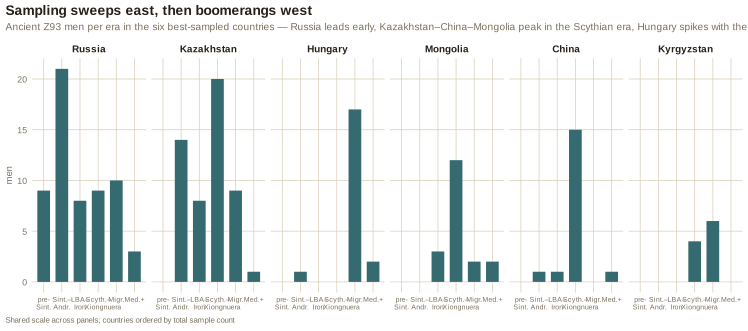
- **The Z2124 share of sampled ancient Z93 rises through time** — 0% before Sintashta, ~51% in the Sintashta–Andronovo era, ~67% in the Scythian–Saka–Xiongnu era, ~70% in the Migration era — while sampling geography sweeps east to Kazakhstan, Xinjiang and Mongolia, then boomerangs west to Hungary with the Hun–Avar movements. The direction replicates in two disjoint call pipelines (p = 0.047 audit, p = 0.012 register); the exact percentages carry coverage and burial-visibility confounds and are not read as demography.
- **The modern map splits clean:** L657 is India–Pakistan–Sri Lanka–Bangladesh (Panjabi plurality among testers); Z2125* is Pashtun–Baluchi; S23592 peaks in Kyrgyzstan; Z2122 carries the Ashkenazi Levite cluster westward — and the apparent Z2123 "Caucasus peak" is largely one intensive testing project, a bias we publish rather than the geography.
- **The 2026 Akbari release publishes no Y-haplogroup calls.** Its own tables carry no Y column and anonymize the country of all 9,497 new individuals; every circulating "Akbari Z93 map" is downstream re-processing of the raw sequences by third parties.
- **Migration claims are graded, not asserted** — a four-model interpretation panel converged on eight steps and, just as usefully, on three claims this data cannot license.
### Start With One Man (anchor: #one-man)
Around 801 BCE, a man was buried at Butkara II in the Swat valley of what is now Pakistan. His Y chromosome places him on the Y3 arm of haplogroup R1a-Z93 — the arm that today includes L657, the largest R1a lineage of South Asia, carried by tens of millions of men from Punjab to Bengal to Sri Lanka. In the ancient record this analysis assembled from AADR v66 genotypes — 212 sampled Z93 males spanning four thousand years — he is the *only* man before the common era who sits on that arm. Hold that singularity loosely: it will turn out to be a fact about the measuring instrument as much as about the past.
Everything else in this analysis radiates from that asymmetry. The arm that owns the modern subcontinent is nearly invisible in the ancient record; the arm that fills the ancient record — Z2124, the East-Iranian branch — is a minority almost everywhere south of the Hindu Kush today. This page measures that inversion across five datasets that fail in different ways, charts it, stress-tests it, and ends with graded guesses about the migrations behind it — and the future samples that would kill each guess.
### Every Ancient Z93 Man, in Time (anchor: #every-man)
.](/images/blog/z93/hero-ancient-timeline.svg)
Three features carry the story. The nine men older than the Sintashta horizon are all Russian forest-steppe burials on basal lineages — the Fatyanovo–Abashevo world of the Volga–Oka. The Z2124 arm enters the record inside the Sintashta–Andronovo window and thereafter dominates it: the Tamir Ulaan Khoshuu Xiongnu cemetery alone contributes sixteen R1a males (ten Z2125, four Z95; Keyser 2020). And within this dataset the Y3 arm's ancient silence is broken exactly once before the common era — the Butkara II man — with a handful of later appearances (the Alai valley, medieval Volga communities). In an independent re-analysis of the 10,016-genome Akbari 2026 release by a community pipeline — necessary because the release itself publishes **no Y-haplogroup calls at all** — the same structure repeats: 145 men below Z94, the Z2124 arm populated throughout, and L657 absent from the entire call set.
The silence, however, is partly the instrument. The 1240k genotype panel behind the audit barely covers the Y3 arm's defining markers — the marker-discard problem quantified in the method section — and where whole Y sequences have been re-called, the arm fills in. FTDNA's Discover tree, which re-processes published ancients at sequence level, places a dozen pre-CE men on the Y3 side: one at Y2 itself around 1795 BCE (an Akbari-release sample whose geography the release withholds), the Nepluyevsky Srubnaya teenager b8-2 (~1760 BCE, southern Urals), and — crucially, in the *west* — Iron Age men of the Middle Don forest-steppe: a Scythian at Kolbino I (~375 BCE), two men at Semiluk, and a Sarmatian at Nesvetay. The first three are from Andreeva and colleagues (2025), who report R-Y2, the direct parent of L657's block, as one of the two predominant lineages among their Middle Don males — the other, R-Y2631, sits on the Z2122 side, so *both* arms were present in the western steppe's Iron Age. The same study finds no direct paternal continuity between the local Bronze Age Srubnaya men and these Scythian-era lineages. Butkara II remains the arm's oldest man with a South Asian address; he is no longer its only pre-CE witness.
### The Z2124 Arm Takes Over the Record (anchor: #takeover)
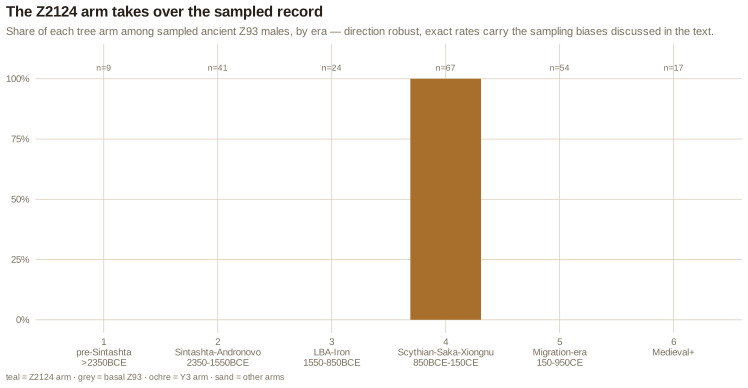
The formal checks (full R output in [Method](#method)): the logistic trend of Z2124-arm membership on date is significant at conventional thresholds; a correspondence analysis puts 74% of the table's inertia on a single dimension that simply is the time axis; and a west-vs-east test for basal-lineage enrichment returns a clean null (Fisher p = 0.73). What the composition chart cannot say is *why* — expansion, drift, burial-rite visibility, and coverage improvements in later samples all push the same direction; the robustness assessment quantifies each.
### East, Then the Boomerang West (anchor: #sweep)
.](/images/blog/z93/ancient-map.svg)
Xinjiang deserves its own sentence: its first Z94-arm man appears at Tangbalesayi around 1566 BCE, an Iron Age site in the Saka horizon carries S23592, and the one genotype-corroborated ancient L657 *candidate* anywhere — Guanjingtai 7, ~77 BCE, examined at length in the [companion article](https://research.indoaryan.com/origin-of-r1a-among-indo-aryans) — sits on the same corridor. The eastward sweep is not just sampling: it is also the Saka–Xiongnu world in which these lineages demonstrably lived.
### The Modern Map Inverts the Ancient One (anchor: #modern-map)
.](/images/blog/z93/modern-map.svg)
The census behind the chart is the complete FTDNA public haplotree subtree under Z93 — every branch the site's click-to-expand tree can reach, pulled as one file — and its headline is the zero: Ukraine (0 of 154), Poland (0 of 143) and Lithuania (0 of 52) report not a single Y3-arm kit, while India runs 135 of 193 the other way and the Gulf countries carry the Arab L657 cluster (Saudi Arabia 126, Kuwait 29, UAE 29 on the Y3 arm). Tested formally — South Asia's four countries against Eastern Europe's five, Y3 arm against Z2124 arm — the split gives a Fisher odds ratio near 209 (p ≈ 6 × 10−139): whatever tester bias contributes, a signal this size is not recruitment noise. The smaller, independently curated YFull census (1,085 samples) partitions the same way, with strata FTDNA's arm view collapses (mutually exclusive, partition verified to sum exactly): **L657** — India 37, Pakistan 16, Sri Lanka 9, Bangladesh 8, with a Panjabi plurality among self-reports. **Z2125*** — Pakistan 8, Afghanistan 8, Pashto and Baluchi tags leading. **Z2123** — the raw counts are towered by Karachay-Balkar (99) and Adyghe (41) self-reports from one intensive Caucasus testing project; we publish that as recruitment bias, not as a Caucasus origin. **S23592** — Kyrgyzstan 17, the steppe arm that stayed nomad. **Z2122** — England, Yiddish (the Ashkenazi Levite M582 cluster) and Levant flags, the arm that went west.
A small non-random cross-check points the same way: in the public FTDNA Punjabi (India & Pakistan) project, twenty of the twenty-one R1a men among fifty-three with Y results are L657, and the Big Y testers among them resolve into eleven distinct terminal branches. Self-selected tester data, offered as texture, not as a frequency estimate.
Published anchors that survive subclade resolution: Underhill 2015 — 98.4% of Central/South Asian R1a is Z93; Z2125 above 40% among Kyrgyz and Afghan Pashtuns; basal Z93* at 1–8% in every Iranian population and above 30% in the Altai. Haber 2012 — Afghan R1a: Pashtun 51%, Tajik 30%, Uzbek 18%, Hazara 7%. Pamjav 2012 — all 53 of 53 Malaysian-Indian R1a chromosomes are Z93. Chang 2023 — Chinese Hui carry Z93 at 14.4% (Xinjiang Altay) and 10.4% (Ningxia), absent from Hui elsewhere. Behar 2013 carries the regional table behind the Levite story. There is still no caste-stratified Z93 typing for India in the literature — the deepest available resolution for Punjab remains the 1000 Genomes Lahore males, where our audit finds 16 of 44 Y-called men (36%) on Z93 across several deep subclades.
### Robustness and Bias Assessment (anchor: #survives)
Every quantitative claim on this page was subjected to an adversarial review and, where a second dataset existed, to independent replication. The table reports each test, its result in both datasets, and the assessment that governs how the claim is worded elsewhere on the page.
ClaimAADR v66 audit (n = 212)FTDNA register (n = 362, disjoint pipeline)Assessment
Z2124 share rises through timelogistic coef −0.27, p = 0.047coef −0.281, p = 0.012Direction replicated across two call pipelines; magnitudes remain non-publishable as demography (cemetery patrilines violate independence, era bins are analyst choices)
Z2124 share by era0% → 51% → 54% → 67% → 70%8% → 83% → 86% → 78% → 73% → 80%Same shape; the register's earlier, sharper takeover reflects Big-Y resolution enrichment, quantified in the receipt
Pre-Sintashta Z2124 absent0 of 9 — refused as a claim2 of 24 presentRefusal vindicated: absence in the audit was a sample-size artifact
Modern South Asia / Eastern Europe inversion—Fisher OR ≈ 209, p ≈ 6 × 10−139Signal exceeds any plausible recruitment-bias contribution; country self-report caveats stand
Pre-CE Y3-arm presence1 of 212 (Butkara II)13 of 362, incl. 5 western forest-steppeThe audit's singleton was a resolution artifact of the 1240k marker panel, not a sampling fact
Three confounds operate on any ancient Y series from this region, and none can currently be removed by analysis. Coverage: low-coverage samples default to basal calls, so part of any "basal declines through time" signal is sequencing improving. Burial visibility: kurgan-building patrilineal cultures enter the record at rates cremating populations — including L657's presumed heartland — cannot, and Ghalichi and colleagues (2026) measure the mechanism directly: Iron Age elite kurgans hold identity-by-descent-linked dynasties spanning cemeteries, with reduced effective population size, so an elite cemetery re-samples a family rather than sampling a population. Drift: in populations of steppe-community size, neutral turnover alone reshuffles clade ratios on a two-millennium horizon. Two further claims are therefore not made anywhere on this page: that Z2123 has a Caucasus origin (the modern peak is one project's recruitment), and any dated statement of L657's entry into South Asia (the [companion article](https://research.indoaryan.com/origin-of-r1a-among-indo-aryans) documents the discarded-marker mechanics and the ≤31% detectability ceiling that manufacture its ancient invisibility).
### Dated Lineages Against the Documented Record (anchor: #correlates)
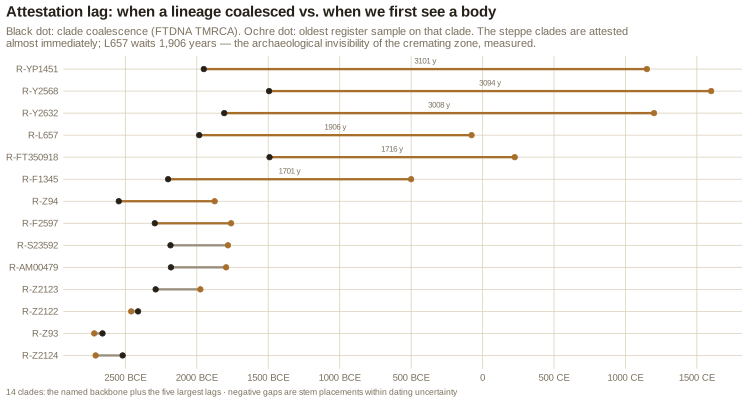
FTDNA's tree carries formation and coalescence estimates with 68% confidence intervals for every node, computed from sequence divergence independently of any archaeological or historical input. That independence makes the following alignments informative rather than circular — with the standing caution that a coalescence date records when surviving lines last share an ancestor, not when a population moved, and that alignment is not causation.
.](/images/blog/z93/branch-formation.svg)
LineageCoalescence (68% CI)Documented horizonCorrelate
R-Z932660 BCE [3008–2356]Fatyanovo–Abashevo forest-steppe, c. 2900–2100 BCECoalescence precedes the first Sintashta fortified settlement by five to eight centuries (radiocarbon corpus 2200–1770 calBC; Sintashta II early phase 2004–1852 calBC). The structure is older than the culture that amplified it.
Z94 → Z2124 → Z2122/Z2125 radiationfour nodes, 2660–2415 BCE, overlapping CIspre-SintashtaA multifurcation compressed into roughly two centuries — the "burst" regime Poznik and colleagues (2016) identified as the dominant mode of male-line expansion — completed before the Sintashta horizon opens. Sintashta amplified existing branches; it did not create them.
R-L6571983 BCE [2300–1707]Steppe-to-South-Asia transfer window, 1900–1500 BCECoalescence sits at the opening of the narrow window Narasimhan and colleagues (2019) derive for steppe ancestry reaching South Asia (Swat admixture dates ~1900–1500 BCE; R1a-Z93 at 100% in Central_Steppe_MLBA males). First physical attestation follows twelve centuries later (Butkara II, 801 BCE).
R-Y2631930 BCE [1297–617]Cimmerian–early Scythian transition, 9th–7th c. BCECoalescence in the pre-Scythian Pontic transition; carriers appear in Middle Don Scythian-period burials by 375–300 BCE (Andreeva 2025), alongside Y3-arm men — the western steppe's Iron Age carried both arms.
Z2124 subclades in the Carpathian Basinregister cluster 350–900 CEHun, Avar and Hungarian-conquest arrivals, 5th–9th c. CEMaróti and colleagues (2022): the Hun immigrant-core males carry R1a-Z94, 10 of 23 European Hun Y calls are Z93, one Late Avar cemetery holds three Z94 men on European genomes, and conquest-period Z94 carriers show Hun-related autosomal ancestry. The register's seventeen Hungary samples are the physical trace of this documented sequence.
Y3-arm men, Volga-Kamafour samples, c. 900 CEKarayakupovo horizon — the Magyar source populationGyuris and colleagues (2025) identify the Volga-Kama Karayakupovo communities as the primary source of the 10th-century Hungarians; four Y3-arm men sit inside that milieu, 2,500 km northwest of the arm's modern center of gravity.
R-MF84025 (below L657)756 CE [493–977]early-medieval South Asian founder classOne of many young, high-frequency South Asian founder clades in the age class Balaresque and colleagues (2015) documented across Asia — eleven descent clusters expanding 2100 BCE–1100 CE, the historical-period ones concentrated in pastoral-nomad polities, the extreme case being the ~1000-year-old star cluster of Zerjal and colleagues (2003).
Kyrgyz Z2125 double founder~1200 CE (community TMRCA estimates)Mongol imperial consolidation, 13th c.Two stacked founder clusters dating to the Mongol era, in the same age class and social mechanism — hereditary elite reproductive advantage — as the Zerjal cluster. Community-derived dates; graded interpretive.
The pattern across the table is a three-pulse structure: branch formation in the East European forest-steppe c. 2700–2400 BCE; amplification and southward transfer through the Sintashta–Andronovo world c. 2100–1500 BCE; then a long sequence of historically documented founder events — Scythian, Hunnic, Magyar, medieval South Asian, Mongol-era — each of which left a dated, named signature in the tree. This is the same punctuated regime Poznik and colleagues identified genome-wide, here resolved to a single haplogroup against a documented political history.
### Eight Best Guesses, Graded (anchor: #migrations)
Four frontier models read the full data brief under different lenses — steppe archaeology, formal phylogeography, adversarial skepticism, and South/Central-Asian historical synthesis — and this is where they converged. "Well-supported" means the claim holds in multiple datasets and survived adversarial review.
- **Z93 coalesces in the Eastern European forest-steppe, c. 3100–2600 BCE — plausible.** The oldest carriers are all Volga–Oka–Ural men on basal lineages; nine samples from one region cannot exclude an origin further east.
- **The Sintashta transition amplifies the Z2124 arm, c. 2200–1800 BCE — well-supported as amplification, not origination.**
- **Andronovo networks carry Z2124 east, c. 1800–1500 BCE — well-supported;** Kazakhstan reaches parity with Russia, and Xinjiang's first appearance (~1566 BCE) belongs to this pulse.
- **The southern arm departs toward the subcontinent in the same window — plausible in timing, unsampled in route.** Butkara II proves arrival by the early Iron Age; everything between the steppe and Swat is a sampling gap. Andreeva's Middle Don men add a useful complication: the Y3 arm was still present in the *western* forest-steppe in the Iron Age, with no paternal continuity from the local Srubnaya population — movement on multiple fronts, not a single southbound departure.
- **Inside South Asia, endogamy amplifies L657 into the subcontinent's largest R1a subclade — well-supported as a social process;** its Bengali and Sri Lankan extensions track later historical movements, its Gulf presence is modern labour migration.
- **Saka–Scythian consolidation spreads Z2125/Z2123/S23592 across the eastern steppe, c. 850–150 BCE — well-supported at horizon level;** tying clades to named tribes (Yuezhi, Wusun) stays speculative without Ili-valley ancient DNA.
- **The Hun–Avar era returns Z2124 lineages to Europe, c. 350–900 CE — well-supported broadly;** distinguishing Hun from Avar from incorporated groups is beyond Y data alone.
- **Medieval founder events reshape the modern map — plausible, community-quantified:** project analyses attribute the Kyrgyz Z2125 peak to two stacked founder clusters with TMRCAs near 1200 CE, and Pashtun R1a to a young pan-tribal cluster (TMRCA ~0 CE) over an older diverse substrate — testable hypotheses not yet in the literature.
Where the lenses disagreed, the disagreement is the finding: the archaeology lens reads the Z2124 rise as expansion; the adversarial review reproduces most of it from coverage, burial visibility and drift; the resolution is that the *direction* is real across three independently biased datasets while every *rate* remains model-dependent.
### Falsifiable Predictions (anchor: #predictions)
- **Pre-2350 BCE samples from central/eastern Kazakhstan stay Z2124-negative** if the Urals-region formation reading is right; one early eastern Z2124 man falsifies it.
- **Future LBA/early-Iron sampling of the Hindu Kush–NW subcontinent corridor yields Y3/L657-side men at substantial frequency** among Z93 carriers; continued read-level absence would force late-entry models.
- **Read-level re-analysis of high-coverage "Z94*" steppe genomes moves men below Y3 or Z2124** — the basal pile is partly a coverage artifact and should shrink.
- **Deep sequencing of Kyrgyz Z2125 keeps collapsing into few clusters younger than 1000 CE**, if the medieval-founder reading is right, rather than a diverse Iron Age spectrum.
### Method, Data and Code (anchor: #method)
**Modern layer:** two independent tester censuses, both read 2026-08-18. FTDNA's public haplotree bulk endpoint yields the complete Z93 subtree — 1,867 subclades, 8,417 kits (2,246 Big Y), per-node country tags — which drives the modern-map chart. The YFull v14.05.00 tree pages for Z93 and nine subclades were retrieved the same day and every sample flag extracted per subtree; ten mutually exclusive strata were computed by multiset subtraction, and the partition reconciles exactly with the Z93 total (1,085 = 1,085). **Ancient tracking:** alongside the AADR audit, FTDNA Discover's per-clade ancient panels were crawled across the subtree and deduplicated into a running register of ancient Z93 samples with terminal clade, site, coordinates, date and source study — published below and maintained as new clade pages surface samples. **Ancient layer:** a project audit joining every usable ancient male Y call in AADR v66 to the YFull tree (males only, QC-filtered, deduplicated; n=212), aggregated in R — era tables, Fisher tests, logistic trend, correspondence analysis, Shannon diversity. **Independent check:** a third-party community re-analysis of the Akbari 2026 raw sequences (whose own release contains no Y calls); its calls are unrefereed and used only as a shape-check, never for individual claims. **Charts:** ggplot2, one chart per claim, shared scales on small multiples.
- [Ancient era × clade row-level table](https://research.indoaryan.com/data/z93-distribution/z93-ancient-era-clade-2026-08-18.csv) — 212 males with sample IDs, dates, localities, publications.
- [Modern country × stratum matrix](https://research.indoaryan.com/data/z93-distribution/z93-modern-country-x-stratum-2026-08-18.csv).
- [Full R analysis output](https://research.indoaryan.com/data/z93-distribution/z93-distribution-analysis-2026-08-18.md) — every test in this page, with its numbers.
- Executable source: [analysis](https://research.indoaryan.com/data/z93-distribution/z93_distribution_analysis.R) · [register replication](https://research.indoaryan.com/data/z93-distribution/z93_ftdna_register_analysis.R) · [charts](https://research.indoaryan.com/data/z93-distribution/z93_distribution_charts.R) — the exact R scripts behind the receipts and figures, runnable against the CSVs above.
- [FTDNA haplotree modern census](https://research.indoaryan.com/data/z93-distribution/ftdna-modern-country-x-arm-2026-08-18.csv) — 114 countries × three arms, from all 1,867 Z93 subclades.
- [FTDNA register replication analysis](https://research.indoaryan.com/data/z93-distribution/z93-ftdna-register-analysis-2026-08-18.md) — era × arm table, independent logistic trend (p = 0.012), the full Y3-arm ancient roster, and the modern-inversion Fisher test.
- [FTDNA Discover ancient register](https://research.indoaryan.com/data/z93-distribution/ftdna-ancient-samples-z93-2026-08-18.csv) — 363 deduplicated ancient Z93 samples (one archaic reference individual removed in cleaning) with terminal clade, site, coordinates, date, culture and source study (of ~665 Discover counts under Z93; the remainder sit on small uncrawled branches). Largest sources: Akbari 2026 re-calls (173), Narasimhan 2019 (30), Gnecchi-Ruscone 2021 (21).
- External: [UYSD](https://ysnp.erasmusmc.nl) (peer-reviewed per-country SNP frequency maps; Europe-weighted) · [YFull R-Z93](https://www.yfull.com/tree/R-Z93/).
Interpretation caveat, stated once and meant everywhere: tester flags record who tests, excavation records record who was buried and dug, and no Y tree encodes language or ethnicity. The convergence of three differently-biased datasets is the strongest statement this page makes; every migration sentence above it is a graded hypothesis, and the predictions section is how they die.
### Primary references
- [Underhill et al. 2015](https://pmc.ncbi.nlm.nih.gov/articles/PMC4266736/) — the only broad per-population R1a subclade survey (16,244 males).
- [Pamjav et al. 2012](https://doi.org/10.1002/ajpa.22167) — discovery of the Z282/Z93 split.
- [Behar et al. 2013](https://doi.org/10.1038/ncomms3928) — regional R1a clade table; the Levite M582 lineage.
- [Haber et al. 2012](https://doi.org/10.1371/journal.pone.0034288) — Afghan ethnic-group frequencies.
- [Chang et al. 2023](https://doi.org/10.1353/hub.2023.a954690) — Hui Z93 frequencies, Xinjiang/Ningxia.
- [Keyser et al. 2020](https://doi.org/10.1007/s00439-020-02209-4) — Xiongnu cemetery Y-lineages.
- Narasimhan et al. 2019 — Steppe_MLBA and the Swat transect.
- [Akbari et al. 2026](https://www.nature.com/articles/s41586-026-10358-1) — the 10,016-genome release (no Y calls published; see Method).
- [Andreeva et al. 2025](https://doi.org/10.1126/sciadv.ads8179) — Middle Don Scythians; R-Y2 and R-Y2631 predominant, no Srubnaya paternal continuity (with the March 2026 erratum, which does not touch the Y calls).
- [Ghalichi et al. 2026](https://doi.org/10.1126/sciadv.aef0108) — elite dynastic rule among Iron Age steppe nomads; the kurgan-visibility mechanism measured directly.
- [FTDNA Discover R-Z93](https://discover.familytreedna.com/y-dna/R-Z93/tree) — sequence-level re-calls of published ancients and the tester census used for the cross-checks above (read 2026-08-18).
- [Poznik et al. 2016](https://doi.org/10.1038/ng.3559) — punctuated bursts as the dominant mode of male-line expansion.
- [Zerjal et al. 2003](https://doi.org/10.1086/367774) — the ~1000-year-old star cluster; social selection on a single patriline.
- [Balaresque et al. 2015](https://doi.org/10.1038/ejhg.2014.285) — eleven Asian descent clusters, 2100 BCE–1100 CE.
- [Maróti et al. 2022](https://doi.org/10.1016/j.cub.2022.04.093) — Hun/Avar/conquest-period Y lineages in the Carpathian Basin, incl. R1a-Z94 in the Hun immigrant core.
- [Gyuris et al. 2025](https://doi.org/10.1101/2024.07.21.599526) — the Karayakupovo horizon as the Magyar source population; Volga-Kama cemeteries.
- [Epimakhov et al. 2023](https://doi.org/10.1017/RDC.2023.62) — Southern Urals Bronze Age radiocarbon chronology; Sintashta phase 2004–1852 calBC.
- [Ralf et al. 2025](https://www.nature.com/articles/s41431-025-01854-5) — the Universal Y-SNP Database.
---
## Article: Origin of R1a Haplogroup among Indo-Aryans
**Category:** Ancient DNA | **Era:** steppe | **Published:** 2025-08-30
**Source URL:** https://research.indoaryan.com/origin-of-r1a-among-indo-aryans
### Evidence statement
- **"R1a" is two sister branches wearing one name.** Over 96% of European R1a belongs to Z282; 98.4% of Central and South Asian R1a belongs to Z93. The two separated roughly five thousand years ago and co-occur at meaningful frequency only around the Near East and Caucasus.
- **Below Z94 the split repeats:** the Y3 > L657 arm is South Asian (Indo-Aryan association); the Z2124 arm is Central Asian and East-Iranian, and carries essentially every Bronze Age steppe man *so far placed* below Z94.
- **Verified personal line (abridged):** R-M198 → R-M417 → R-Z93 → R-Z94 → R-L657 → R-FTF40903, six markers directly confirmed in the raw Big-Y data; the terminal clade formed ~1,250 years ago and its few known members on YFull are Punjabi.
- **Not verified:** any established ancient carrier at or below R-L657. The ancient record counts 212 Z93 men and reaches zero exactly at L657 — a silence that is partly real under-sampling and partly a measurable artifact of how callers handle L657's defining marker.
- **Corrections stand:** the former DS32 "first ancient L657" claim remains withdrawn; the Guanjingtai 7 candidate is corroborated at genotype level but not established at read level.
### One Name, Two Continents (anchor: #one-name-two-continents)
The deep story is brief. Haplogroup R's early history runs through the Upper Palaeolithic hunter-gatherers of inner Eurasia — the Mal'ta boy of South Siberia carries a basal R lineage — and its R1a branch is defined by M420, whose rare surviving basal lineages cluster today around Iran and eastern Turkey (Underhill 2015; modern survivor geography, not a located origin). The expansion that matters here is much younger: R1a-M417, whose living carriers descend from a common ancestor roughly 5,400 years ago on the YFull clock (Underhill and colleagues' sequence-based estimate is ~5,800 years, CI 4,800–6,800). Within a few centuries on these clocks, M417's descendants split into two branches that went opposite ways.
Underhill et al. (2015) typed 16,244 men from 126 populations and found the division nearly absolute: of 1,693 European R1a-M417 chromosomes, more than 96% belong to **Z282**; of 490 Central and South Asian R1a chromosomes, 98.4% belong to **Z93**. The two co-occur at meaningful frequency only in the Near East and the Caucasus. On the current YFull tree (v14.05.00, read 2026-08-18) the testers tell the same story: the Z282 subtree is dominated by Russian (429), Polish (204) and other European samples, while the Z93 world below is South and Central Asian. Every argument that quotes an undifferentiated "R1a frequency" — and that includes most of the pre-2012 literature — is comparing two brotherhoods that separated five thousand years ago.
### The Frequency Landscape (anchor: #frequency-landscape)
The table collects published frequencies with their sources. Two cautions travel with it. Studies before the Z282/Z93 split was discovered (Pamjav et al., 2012) report undifferentiated R1a; and frequency alone cannot arbitrate origins — high frequency can reflect founder effects and drift as easily as antiquity, which is why the Kyrgyz maximum and the Brahmin maximum, on opposite sides of the tree, both exist.
PopulationFrequencyMarker levelSource
India, overall male lineages17.5%R1a-M17[Silva et al. 2017](https://bmcecolevol.biomedcentral.com/articles/10.1186/s12862-017-0936-9), after Underhill 2015
India, regional gradient (1000 Genomes)~25% NW · ~20% NE · ~14% SWest-Eurasian paternal lineages as a class (R1a foremost) — an ancestry grouping, not one markerSilva et al. 2017
Upper-caste Indo-European speakersapproaching 50%R1aSilva et al. 2017
West Bengal Brahmins (highest value in their survey)72.2%R1a1*[Sharma et al. 2009](https://www.nature.com/articles/jhg20082)
Chenchu (Dravidian tribe)26%R1a[Kivisild et al. 2003](https://pmc.ncbi.nlm.nih.gov/articles/PMC379225/)
Jats, India+Pakistan (n = 302)28.5% haplogroup RSTR-predicted, top level only[Mahal & Matsoukas 2017](https://doi.org/10.3389/fgene.2017.00121)
Afghan Pashtun51.0%R1a1a-M17[Haber et al. 2012](https://doi.org/10.1371/journal.pone.0034288) (n = 204)
Afghan Tajik30.4%R1a1a-M17Haber et al. 2012
Afghan Uzbek · Hazara17.6% · 6.7%R1a1a-M17Haber et al. 2012
Kyrgyzstan; Afghan Pashtun>40%R1a-Z2125 specifically[Underhill et al. 2015](https://pmc.ncbi.nlm.nih.gov/articles/PMC4266736/)
Iranian ethnic groups0–25% by groupR1a-M198[Grugni et al. 2012](https://doi.org/10.1371/journal.pone.0041252) (n = 938)
Iranian populations, paragroup1–8% everywhereZ93*Underhill et al. 2015
Altai region, South Siberia>30%Z93*Underhill et al. 2015
Czech Rep. · Slovakia · Poland · W. Belarus>20%M458 (European Z282 branch)Underhill et al. 2015
Norway~20%Z284 (Scandinavian Z282 branch)Underhill et al. 2015
The Jat figure deserves its caveat spelled out: both Mahal & Matsoukas studies predict haplogroups from STR profiles at the top level only, so they can say "haplogroup R is the second most common Jat lineage after L" — they cannot say anything about Z93, Z94 or L657. No published study yet types Jat Sikhs at proper subclade resolution; the deepest available resolution for Punjab comes from the 1000 Genomes Punjabi (Lahore) males, where a project analysis (the same AADR-and-YFull audit used throughout this article) finds sixteen of forty-four Y-called males — 36% — carrying R1a-Z93, spread across several deep subclades rather than one founder cluster. The European branches are the mirror check: M458 and its sibling M558, which reach 20–33% across Central and Eastern Europe, are nearly absent in Underhill's 301 Central Asian and South Siberian R1a samples (4 carriers), exactly as the schism predicts.
### The Differentiation of R-Z94 (anchor: #z94-differentiation)
Below Z93 sits Z94, and below Z94 the tree splits the way the frequency map hinted. The ISOGG long-form codes (2016–2019 scheme, which collapses the Y3-to-L657 stretch into a single step) are given for cross-reference; ages are YFull v14.05.00 (formed / TMRCA, years before present); the flag counts are YFull tester geography — an observation about who tests, not a measurement of where a clade arose.
**R-Z94**
4600/4600 ybp. The Indo-Iranian trunk below Z93 (5100/4600 ybp).
**R-Y3 › Y2 › Y27 › L657** R1a1a1b2a1 (= L657 in ISOGG's collapsed tree)
The **Indo-Aryan-associated arm**. Y3 4600/4600; L657 4100/4100 ybp — the largest South Asian R1a subclade (Silva 2017); Underhill's M780 sits in this branch block. YFull subtree flags: India 37, Panjabi 28, Pakistan 16, Sri Lanka 9, Bengali 8, Bangladesh 8, plus Gulf Arab lineages.
**R-Z2124** R1a1a1b2a2
The **East-Iranian-associated arm**, 4600/4300 ybp — its actual spread runs wider, from the Caucasus to China. Subtree flags: 94 ancient-DNA samples (the most of any Z94 branch), Adyghe 41, Tatar 29, Mandarin 23, Turkey 22, Kyrgyzstan 18, Afghanistan 17, Pashto 16.
**R-Z2125** R1a1a1b2a2a
4300/4300 ybp. Over 40% of Kyrgyz and Afghan Pashtun men (Underhill 2015). Ten of the sixteen R1a males in the Xiongnu cemetery of Tamir Ulaan Khoshuu are Z2125 (Keyser 2020).
**R-Z2123** R1a1a1b2a2a1
4300/4100 ybp. Afghan Pashtun and Tajik heavy on YFull (Kandahar, Kabul, Zabul; Dari flags), with Bashkir and South Indian branches.
**R-YP413**
Mixed Afghan, Pakistani Punjab, Iraqi and Balochi samples on YFull — an Afghan-to-South-Asian scatter. Finer ethnographic tags circulate in tester databases but are not published literature.
**R-S23592**
4300/4300 ybp. The steppe arm that stayed nomad: its ancients run from Alakul Bronze Age (Maitan I6789, I6793) through Saka to the Xiongnu–Hun horizon; modern flags are Kyrgyz, Chechen, Tatar and a steppe-refracted European scatter. (Sometimes miscredited to the Xianbei; the sampled horizon is Xiongnu-era.)
**R-Z2122** R1a1a1b2a2b
4300/4300 ybp. West Asian: Iranian, Iraqi, Armenian and Levantine lineages — the ISOGG "Persian" label is too narrow — including M582, the Ashkenazi Levite founder lineage of Near Eastern origin (Rootsi 2013).
The same tree, read as a tally, states the asymmetry this article turns on. Counting every sample YFull marks in each subtree (v14.05.00, read 2026-08-18; indented rows nest *inside* their parent's count — Z2123 and S23592 sit within Z2125's 62, so rows do not sum):
CladeAncient-DNA samples in subtreeLeading modern flags
R-Z94 (whole trunk)99India 49 · Adyghe 41 · Tatar 32 · Panjabi 31 · Pakistan 28
R-Z2124 (East-Iranian arm)**94**Adyghe 41 · Tatar 29 · Mandarin 23 · Turkey 22 · Kyrgyzstan 18 · Afghanistan 17
— R-Z212562Kyrgyzstan · Afghanistan · Pashto
— R-Z212329Pashto 12 · India 10 · Dari 10 · Afghanistan 9
— R-S2359232Kyrgyzstan 17 · Tatar 9 · Chechen 6
— R-Z212231England · Yiddish (Levite cluster) · Ukraine · Palestine
R-Y3 (Indo-Aryan arm)**3**India 37 · Panjabi 28 · Pakistan 16 · Sri Lanka 9 · Bengali 8
— R-L657 and below**0**India 37 · Panjabi 28 · Pakistan 16 · Bangladesh 8 · Qatar 6
Ninety-four of the ninety-nine ancient men sit on the East-Iranian arm, three on the Indo-Aryan arm above L657, and the remaining two on minor Z94 branches (the Y40 side); none sits at or below L657. The moderns invert the picture: the L657 subtree is the South Asian crowd, the Z2124 subtree is everyone the steppe scattered. Both halves are database tallies, not the Bronze Age itself — the modern rows are biased toward who buys sequencing, and the ancient rows carry their own biases of excavation geography, capture design and publication. What they share is the shape the rest of this article explains.
Two features of this structure carry the historical argument. First, the four deep Z93 subclades form a multifurcation that ten megabases of sequence cannot resolve — a star-like burst, the signature of explosive expansion rather than gradual diffusion (Underhill 2015). Second, the arms sort geographically *and* temporally: the Xiongnu males of Tamir Ulaan Khoshuu (1st c. BCE–1st c. CE) are Z2125 and Z95; the Hun, Avar and Hungarian-Conqueror elites carry Z94 and Z2124 branches; the Bronze Age steppe cemeteries fill the Z2124 arm. The steppe kept its own Z93 descendants: the Z2124 arm is documented there from the Sintashta cemeteries to the Xiongnu–Hun horizon, two thousand years of presence — while where and when the southern arm's ancestors moved remains, as the synthesis below says plainly, unsampled.
### Three Layers of Evidence (anchor: #three-layers)
Verified
**SNP topology**
Versioned provider trees and raw Big-Y calls establish which named branches are upstream or downstream of the personal result.
Attested
**Ancient branch calls**
Published samples document related R-Z93/R-Z94 branches in ancient Steppe contexts, subject to coverage, damage and marker quality.
Interpretive
**Place and people**
Assigning a tree node to a culture, language, migration route, or living community requires evidence beyond the Y tree.
### The Ancient Record and the Coverage Collapse (anchor: #ancient-record)
The ancient side of the Z93 world is rich — until you descend toward L657. Narasimhan et al. (2019) found R1a of the Z93 subtype at 68% frequency among sampled Steppe_MLBA males and in every sampled Central_Steppe_MLBA male; Mathieson et al. (2015) found all six Srubnaya males R1a, four of them resolvable to Z93. A project audit of AADR v66 against the YFull tree (v14.04, males only, QC-filtered, deduplicated per individual) shows what happens on the way down the personal spine. Its counts are wider than the YFull tally above because it joins *every* usable ancient Y call to the tree, whether or not YFull curates the sample — 138 below Z94 against YFull's 99, six on the Y3 side against YFull's three — different denominators, same collapse:
Spine nodeSubtree nodesAncient carriers at or belowOldest
R-Z931,801**212**I0432, Potapovka, ~2925–2491 BCE
R-Z941,589**138**SZ1, Hungary BA, ~3850 BP
R-Y3385**6**I12450, Swat, ~801 BCE
R-Y2375**2**I12450
R-Y27 (M634)370**1**ALN005, Alai valley, ~358 CE
**R-L657**336**0**—
R-Y29 and below99**0**—
212 → 138 → 6 → 2 → 1 → 0. The men who fill the top of that pyramid are the Sintashta and Alakul burials of the southern Urals and Kazakhstan — Kamenny Ambar-5's four men between 1883 and 1789 BCE, Maitan's S23592 pair, Satan's Z2125 man — and every one of them who can be placed below Z94 sits on the Z2124 arm, not the southern one. In this genotype-based census the six Y3-side ancients are late and eastern: the oldest, I12450 from Butkara II in Swat (~801 BCE), is a sibling below Y2, not an L657 carrier. Sequence-level re-calls now extend the arm both back and west of that: FTDNA's Discover placements include a man at Y2 itself around 1795 BCE from the Akbari release, and Andreeva and colleagues (2025) report R-Y2 as one of the two predominant lineages among their Iron Age Middle Don Scythians — the same AM00479 block where this lineage's ancient connections cluster below. Where South Asia itself is concerned, the Swat valley delivers a result that cuts against the modern pattern: among 44 Late Bronze and Iron Age Swat males, only two (~5%) carry R1a-Z93, against roughly 20% steppe ancestry on their autosomes. Narasimhan and colleagues' own sex-bias analysis reads this as steppe ancestry entering those particular communities disproportionately through women (their statistic Z = −3.9), the reverse of the strongly male-biased pattern the same analysis finds in present-day South Asians (Z = +2.7). Two Y chromosomes is a thin base for any valley-level story; the published claim, the small denominator, and the two thousand years between Swat's graves and the modern founder peaks all belong in the same sentence.
The Early Bronze Age serves as the timing control: Damgaard et al. (2018, Science) found the Yamnaya expansion eastward left no detectable genetic impact in South Asia — the southward vector was the Late Bronze Age Sintashta–Andronovo horizon, itself carrying Yamnaya-derived ancestry onward. That matches the autosomal story told in the [companion qpAdm analysis](https://research.indoaryan.com/indo-aryan-qpadm-admixture), and the interactive [migration map](https://research.indoaryan.com/map) plots these same ancient waypoints — Sintashta I0430, Andronovo RISE509, the Swat graves — on the ground.
### Why the Silence Is Partly Manufactured (anchor: #manufactured-silence)
Zero ancient L657 carriers looks like a fact about the Bronze Age. It is partly a fact about software. A project audit of FTDNA's tree data found that L657's defining mutation — a G→A transition at chrY:12,039,158 — is listed in the caller's own discard set, because the identical mutation independently defines a branch inside haplogroup J. The discard file carries 60,115 rows and 27,985 SNP names that collide across haplogroups. The consequence is mechanical for that pipeline: **no caller using FTDNA's marker set can assign R-L657 itself, whatever the capture panel supplies** — a sample could in principle still land *below* L657 where a panel carries downstream markers. Zero L657 assignments across the latest large ancient release's 9,908 individuals (of whom only the male, Y-covered subset is informative at all) stops being surprising once the defining marker is out of play and the sub-L657 branches are thinly represented on capture panels. Coverage does the rest: in the project's own audit, 41 of 135 relevant males were uninformative simply because their calls stopped above the depth in question.
Damage compounds the problem. L657's G→A is exactly the mutation class that post-mortem cytosine deamination fabricates, so even read-level claims need strict terminal trimming. The clean test point is one node up: **R-M634 (Y27), L657's immediate parent, is defined by a T→A transversion** — a mutation class ancient-DNA damage cannot imitate. A man derived at M634 and ancestral at L657 is a genuine near-miss; a man "derived" at L657 alone might be damage.
How much could still be hiding? The project's detectability bound answers at every level of the denominator: of 135 steppe and Central/South Asian Z93-region males from 3000 BCE–0 CE, 94 were informative at the relevant depth (zero positives — individual-level 95% ceiling ~3%), and among the Sintashta–Andronovo sphere specifically, 13 informative men from 8 cemeteries, zero positives. Zero of thirteen men caps the per-man share at roughly **21%** (95%); treating whole cemeteries as the unit — the most conservative reading, since cemetery members share patrilines — the ceiling on a cemetery containing *any* L657 carrier is roughly **31%**. And since L657's formation estimate (~2100 BCE, with a wide confidence interval) coincides with Sintashta's own beginning, the earlier record is expected to be nearly empty regardless. The silence is real; its evidentiary weight is small.
### The One Candidate: Guanjingtai 7 (anchor: #guanjingtai)
One ancient individual currently stands as a candidate. C3316, "Guanjingtai 7," from the Yili valley of Xinjiang, an Iron Age burial of roughly 161 BCE–8 CE (Kumar et al. 2022, Science). The path to him is itself a lesson in verification. FTDNA's ancient-connections panel displays him against R-L657 — but the project audit found FTDNA returns byte-identical ancient lists for L657 and its parent M634, so that display is a context list, not a placement (the same failure mode that produced, and then retracted, the earlier DS32 claim). The AADR's own caller stops him four nodes above Z93, at R-M459.
The genotypes say more than either. In AADR's published genotype file, C3316 is derived at Z93, at Y2 and Y27 — both transversions, outside the C→T/G→A class that post-mortem deamination produces — and at L657 itself. The transversions corroborate the *upstream placement* hard; the L657 call itself is a single site in exactly the damage-prone class, which is why it cannot carry the claim alone. A control check (I1053, a known Z2124-arm man, ancestral at all four sites) fixes the file's allele orientation — it says nothing about read authenticity. What is missing is read-level confirmation under the project's pre-registered criteria — independent post-trim reads, strand diversity, a contamination bound — none of which can be assessed from genotype calls, and the underlying sequence data sits under restricted access. FTDNA's Discover tree, for what its unpublished pipeline is worth, also places C3316 at R-L657 — an independent caller reaching the same terminal, with its evidence basis equally unverifiable from outside. The project verdict stands as recorded: **candidate — placement strongly corroborated upstream, the L657 call itself not established.** If confirmed, an L657 man on the Iron Age silk-road corridor east of the steppe would be a remarkable data point; until then he is a hypothesis with good posture.
### The Personal Y-DNA Line (anchor: #personal-line)
Six defining markers are directly observed in the raw Big-Y VCF — M198, M417, Z93, Z94, L657 and FTF40903, all PASS, all derived (recorded 1/1 in the VCF's diploid convention; the Y is hemizygous), raw file and provider export agreeing — with the Y3/Y2/Y27 block derived as well. The terminal clade, **R-FTF40903, formed ~1,250 years ago with a TMRCA of ~850 years**, and its few known members on YFull are Punjabi. A young clade whose known members cluster in one region is consistent with a medieval founder lineage of that region — with the standing caveat this article applies everywhere else: tester geography records who tests, not where the common ancestor lived.
The diagram shows the full path with the evidence boundary exposed: the six directly confirmed markers, and the interval — FT197453, F2597, AM00479, M634 in FTDNA's labels — where every ancient relative actually sits, above L657 rather than inside it. The FTDNA ancient-connections panel lists 31 ancient individuals against this stretch of tree, from a Srubnaya-period Urals teenager (Nepluyevsky b8-2, F2597 block) through Scythian-period Middle Don men (AM00479 block) to medieval Volga individuals — shared-node relatives all, direct ancestors none.
{SOHI_RESEARCH.yPathFull.map((marker, index) => {
const confirmed = SOHI_RESEARCH.yMarkers.includes(marker as never);
const ancientBearing = SOHI_RESEARCH.yAncientBearingNodes.includes(marker as never);
const color = ancientBearing ? '#a76f2b' : (confirmed ? '#356b70' : '#4a5568');
const note = ancientBearing
? 'Ancient relatives are placed here — above L657, not inside it'
: (confirmed
? 'Directly confirmed in the personal dataset'
: 'On the verified path; not among the six directly confirmed markers');
return (
**R-{marker}**
{note}
);
})}
No ancient carrier at or below R-L657 — the sampling gap this article is about
Provider clocks describe branching events with uncertainty; they do not date a migration or locate the man in whom a mutation arose. All ages in this article are YFull v14.05.00, read 2026-08-18, and will drift with future tree versions.
### From Tree to Geography (anchor: #geography)
A Y tree records mutation order. Geography enters only when ancient or modern carriers with reliable locations are placed on that topology, and language requires still more. The layered synthesis, updated:
- **R1a-M417 split into a European (Z282) and an Asian (Z93) world ~5,000 years ago;** the modern frequency map preserves that schism almost perfectly.
- **Z94's own differentiation mirrors it at smaller scale:** an Indo-Aryan arm (Y3 > L657, the largest South Asian subclade) and an East-Iranian arm (Z2124: Kyrgyz, Pashtun, Tajik, Persian, and the Xiongnu-era steppe).
- **The ancient record fills the Z2124 arm and the basal nodes** — Sintashta, Alakul, Srubnaya, Saka, Xiongnu — while the L657 arm is ancient-silent, for reasons that are measurably part sampling, part software.
- **Steppe-related autosomal ancestry entered South Asia in the second millennium BCE** (the companion qpAdm analysis), with the Swat valley showing that Y-frequency and autosomal ancestry can decouple locally.
- **L657 then underwent a major founder expansion ancestral to today's South Asian carriers** — Silva et al. (2017) infer at least three subcontinental R1a founder clades — of which R-FTF40903, formed ~1,250 years ago with Punjabi testers, is one late branch.
- **The transition point from Z94 to L657 — its place, culture and carrier — remains unsampled.** That is the open question a future ancient genome will answer.
### Conclusion (anchor: #conclusion)
Seen at continental scale, R1a is not one story but two, and the Indo-Aryan story is the southern half of the Asian one: a Z93 world whose Bronze Age record lives on the steppe, whose East-Iranian arm still stands at peak frequencies among Kyrgyz and Pashtun men, and whose Y3 > L657 arm became the largest R1a subclade of South Asia. The personal line runs down that southern arm to a young terminal clade with Punjabi testers. What the record does not yet contain is the bridge: an established ancient man at or below L657. The nearest thing to him is a genotype-corroborated candidate on the Xinjiang silk road, and the honest verdict on the whole question is the one the coverage table forces — the count of ancient men on related branches collapses from 212 to zero precisely at the node where the South Asian story begins, with under-sampling, thin Y coverage and a discarded marker each suppressing what could be seen, whatever the Bronze Age actually held.
The former claims this article once made beyond that boundary — an ancient DS32 "first L657," a complete paternal turnover, a direct waypoint to modern Indo-Aryans — remain withdrawn. The corrected article is narrower, and for exactly that reason, harder to knock down.
### Primary references
- [Underhill et al. 2015](https://pmc.ncbi.nlm.nih.gov/articles/PMC4266736/), the phylogenetic and geographic structure of R1a (16,244 males, 126 populations).
- [Silva et al. 2017](https://bmcecolevol.biomedcentral.com/articles/10.1186/s12862-017-0936-9), genetic chronology of the Indian Subcontinent; L657 as the largest South Asian subclade.
- Narasimhan et al. 2019, South and Central Asian population formation; Steppe_MLBA 68% Z93; the Swat transect.
- [Mathieson et al. 2015](https://pmc.ncbi.nlm.nih.gov/articles/PMC4918750/), Srubnaya males exclusively R1a, four resolvable to Z93.
- [Keyser et al. 2020](https://doi.org/10.1007/s00439-020-02209-4), Xiongnu cemetery Y-lineages: Z2125 and Z95.
- [Haber et al. 2012](https://doi.org/10.1371/journal.pone.0034288), Afghan ethnic-group Y frequencies.
- [Rootsi et al. 2013](https://doi.org/10.1038/ncomms3928), the Near Eastern origin of the Ashkenazi Levite R1a lineage (M582, under Z2122).
- [Kumar et al. 2022](https://www.science.org/doi/10.1126/science.abk1534), Xinjiang population history; the Guanjingtai site.
- Andreeva et al. 2025, Scythian-period genetic history; Middle Don individuals.
- [YFull YTree v14.05.00](https://www.yfull.com/tree/R-Z94/), ages and sample flags; consult the displayed version.
- Allen Ancient DNA Resource v66.0, ancient-genome metadata and genotypes.
---
## Article: qpAdm Tutorial: Consumer DNA and AADR v66
**Category:** Tutorials | **Era:** modern | **Published:** 2024-07-20
**Source URL:** https://research.indoaryan.com/qpadm-tutorial
### Before you begin
- qpAdm identifies **models that are not rejected** relative to chosen references; it does not discover true ancestors automatically.
- A p-value above 0.05 is not proof, and the highest p-value is not a source ranking.
- Freeze candidate sources and right populations before viewing results; rotate systematically instead of tuning until a favorite model passes.
- Consumer arrays are sparse, diploid views of one person. Treat cross-chip agreement as technical robustness, not biological replication.
### What qpAdm Actually Tests (anchor: #what-qpadm-tests)
qpAdm evaluates whether a target can be represented as a mixture of specified left-side source populations relative to a set of right-side reference populations. Its tail probability comes from a rank test. A low value can reject the proposed model; a high value means the test did not find enough evidence to reject it under that design.
Three consequences follow:
- Different proxy populations can all be plausible because they share the drift qpAdm can see.
- A plausible model can still be historically wrong if the real source is unsampled or the demographic history violates the model assumptions.
- Changing right populations after inspecting results changes the question. Exploratory tuning must be labelled exploratory and confirmed on a frozen design.
### The Reproducible Workflow (anchor: #workflow)
- Audit build, strand, overlap, and privacy
- Freeze targets, sources, rights, and chronology
- Compute f2 and model-free f3/f4 checks
- Rotate models and apply deterministic gates
- Report all survivors and the resolution ceiling
### 1. Environment and Data (anchor: #environment)
This tutorial uses ADMIXTOOLS 2 in R and the AADR {SOHI_RESEARCH.aadrVersion} release. Use Linux, macOS, or WSL with current R and enough storage for the genotype panel and extracted f2 blocks.
# In R
install.packages('remotes')
remotes::install_github('uqrmaie1/admixtools')
library(admixtools)
packageVersion('admixtools')
Record the AADR release DOI, genotype-panel type, ADMIXTOOLS version, operating system, input checksums, and every transformation command. A filename such as “latest” is not sufficient provenance. The code in this tutorial was verified against admixtools 2.0.10; the package API moves, so record the version you installed and re-check argument names against your release rather than trusting any tutorial, this one included.
### 2. Prepare Consumer Data Safely (anchor: #consumer-data)
Raw consumer genotypes are identifying data. Keep them out of public repositories, cloud build logs, screenshots, and browser-only ancestry calculators. Work locally and publish aggregate outputs only. The report service on www.indoaryan.com is held to the same rule: a file you upload there travels over an encrypted connection, is stored encrypted, is used only to produce your report and is never sold, licensed or published; it is disclosed only to the service providers needed to run the service (storage, payment and email delivery), never to advertisers or data brokers; retention is set out in its terms, and you can ask for your copy to be deleted at any time.
Before merging with AADR:
- Confirm the consumer file’s genome build and lift over only with a documented chain.
- Normalize chromosome names, reference/alternate alleles, and strand orientation.
- Remove ambiguous A/T and C/G SNPs unless strand orientation is independently known.
- Resolve duplicate positions and sample identifiers deterministically.
- Measure post-merge overlap; never infer it from the advertised chip size.
- Create a second view only when it represents a genuinely different overlap or QC condition.
A single modern individual can be used as a target for personal exploration, but standard errors and idiosyncratic family history limit population-level interpretation. Do not call one person a representative “Jatt,” “Punjabi,” or “Indo-Aryan population.”
**Platform-bias check.** Consumer arrays and ancient capture data were genotyped on different platforms, and that mismatch can bias f-statistics on its own. [Fournier et al. (2026)](https://genome.cshlp.org/content/early/2026/08/12/gr281262125) publish a compatibility SNP panel selected to minimize cross-platform artifacts; re-fit your accepted models restricted to the intersection of your merge with that panel (keepsnps in extract_f2, or the equivalent genotype-direct filter) and report the shift alongside the restricted fit’s standard error and the post-restriction SNP count — the panel is itself a restriction, so re-apply your minimum-SNP gate. If a headline proportion moves by more than the restricted fit’s standard error, treat platform bias as live rather than assumed away. This is a predeclared screening flag, not a significance test: the restricted and full fits share data, so no single standard error is an exact yardstick for their difference. In the companion analysis this check moved no coefficient by more than two points, well inside each restricted standard error.
### 3. Freeze Hypotheses (anchor: #hypotheses)
Write a machine-readable manifest before running qpAdm. It should name the target, candidate source families, fixed rights, chronological constraints, minimum SNP count, coefficient bounds, p-value threshold, multiple-testing procedure, and sensitivity checks.
target: TARGET_SAMPLE
source_families:
aasi: [AASI_PROXY_1, AASI_PROXY_2]
farmer: [TURAN_PROXY_1, TURAN_PROXY_2]
steppe: [STEPPE_PROXY_1, STEPPE_PROXY_2]
right_fixed: [OUTGROUP_1, OUTGROUP_2, OUTGROUP_3]
gates:
p_min: 0.05
# Feasibility bound. A slightly negative estimate whose standard error
# comfortably overlaps zero is statistical noise, not infeasibility --
# gate on estimate AND uncertainty together, not the point value alone.
coefficients: [0, 1]
require_target_younger_than_sources: true
require_source_order_invariance: true
report_all_survivors: true
The placeholder labels are intentional. Select actual AADR population labels only after checking their archaeological date ranges, sample composition, relatedness exclusions, coverage, and publication metadata.
The right set deserves as much care as the sources, because it does all the discriminating work. Four rules cover most failures: include deep outgroups (an African pair such as Mbuti and Mota anchors the tree); include one reference differentially related to *each* ancestral stream your sources draw from — a right set with no leverage along some axis is how the “unresolved fourth term” trap arises; include no population directly ancestral to, or descended from, a source; and keep every proxy out of the reference set it is judged against (Harney et al., 2021). The [companion analysis’s twelve-population set](https://research.indoaryan.com/indo-aryan-qpadm-admixture#methodology) is a worked instance of these rules, one anchor per stream.
### 4. Compute f2 Blocks (anchor: #f2)
ADMIXTOOLS 2 auto-detects EIGENSTRAT, packed ancestry map, PLINK, and PLINK 2 prefixes. Restrict extraction to the populations needed for the frozen analysis; large, indiscriminate right sets can create conditioning problems.
library(admixtools)
geno_prefix <- '/private/genotypes/analysis_panel'
f2_dir <- '/private/derived/f2_blocks'
analysis_pops <- unique(c(target, sources, right_fixed, rotating_candidates))
extract_f2(
pref = geno_prefix,
outdir = f2_dir,
pops = analysis_pops,
overwrite = FALSE
)
f2_blocks <- f2_from_precomp(f2_dir, pops = analysis_pops)
count_snps(f2_blocks)
The default missingness behavior is deliberately conservative. The choice that actually matters is SNP-set handling: the conservative default computes statistics on SNPs shared across the extracted populations, while allsnps = TRUE computes each statistic on the SNPs available for its own populations. These are different regimes, not interchangeable settings — results can move between them, especially when a sparse consumer target meets heterogeneous-coverage capture data. Choose the regime before inspecting results, state it wherever a number is reported, and confirm key results under the alternative treatment. The companion analysis runs genotype-direct allsnps = TRUE throughout for exactly this reason, states the regime in its Methodology, and stamps it in every raw model receipt.
### 5. Run Model-Free Checks (anchor: #model-free)
Before mixture fitting, ask whether the target displays the broad relationships your hypothesis requires. Admixture f3 can support mixture between populations related to two sources; focused f4 contrasts can test whether the target distinguishes competing proxies.
# Negative f3 with |Z| >= 3 supports admixture between
# populations related to source_a and source_b.
f3_results <- f3(
f2_blocks,
pop1 = target,
pop2 = source_a,
pop3 = source_b
)
# Focused proxy comparison; choose A, B, C, D from a frozen design.
f4_results <- f4(f2_blocks, pop1 = A, pop2 = B, pop3 = C, pop4 = D)
A non-significant f4 result does not prove two sources are identical. It can indicate insufficient resolution at the available SNP overlap.
### 6. Run and Rotate qpAdm (anchor: #qpadm)
Run a predeclared model first, then rotate candidates systematically. The target is not part of the source vector.
fit <- qpadm(
f2_blocks,
left = sources,
right = right_fixed,
target = target
)
fit$weights
fit$rankdrop
fit$popdrop
These are the documented outputs: estimated weights with block-jackknife standard errors, the rank-test table the tail probability comes from, and the nested-model comparison. There is no packaged conditioning diagnostic; near-singular designs announce themselves through exploding standard errors and unstable rank tests, which is why the gates below watch for exactly those symptoms.
For a rotating design, split a frozen candidate pool between left and right while retaining fixed references:
rotation <- qpadm_rotate(
f2_blocks,
leftright = rotating_candidates,
target = target,
rightfix = right_fixed,
full_results = TRUE
)
Use qpadm_multi() when the model grid is explicitly enumerated. Preserve the complete grid, including rejected and infeasible models.
### 7. Apply Acceptance Gates (anchor: #gates)
GateReject or flag whenWhy
Tail probabilityBelow the frozen threshold after the chosen multiplicity treatmentThe specified model is rejected relative to the right set.
CoefficientsOutside [0,1], or uncertainty crosses implausible valuesWeights are infeasible or poorly identified.
ChronologyA population offered as a literal ancestor is younger than the target or the eventA literal ancestor cannot postdate its descendant. A younger population may still stand in for an older related lineage — but then it must be declared a proxy, not an ancestor.
Numerical conditioningStandard errors explode or rank tests destabilize under small design changesThese are the visible symptoms of a near-singular design; collinear rights can make weights appear more precise than they are.
StabilityThe conclusion collapses under source order, chromosome blocks, or leave-one-out checksA robust interpretation should not depend on an arbitrary representation.
CompetitionA simpler or historically better proxy model survives equally wellOne passing model does not identify a unique source.
A note on multiplicity, because qpAdm screening cuts the opposite way from most testing: when you rotate many models, the risk you usually care about is falsely *retaining* inadequate models, and a conventional p-value correction (Bonferroni, Benjamini–Hochberg) lowers the rejection threshold — which retains *more*. Declare before running which error you are controlling. When in doubt, report unadjusted p-values with the complete grid, so readers can apply whatever rule they defend; a correction chosen after seeing the results is tuning by another name.
### 8. Interpret Without Overclaiming (anchor: #interpretation)
Say
**“The model is compatible”**
Name the target, proxies, right set, p-value, weights, uncertainty, SNP count, and software version.
Qualify
**“This proxy ranks well”**
State whether chronology or another prior changed the rank and list statistically similar survivors.
Do not say
**“The highest p-value is the ancestor”**
qpAdm p-values are not posterior probabilities of cultural or genealogical identity.
Do not interpret negative coefficients as proof that a culture contributed nothing. Do not interpret failure of one Gonur group as absence of all BMAC-related ancestry. Do not combine two chips from the same person and call them independent replication.
Three further traps deserve their own warnings, because each produces a claim that looks rigorous and is not:
- **Stability across collinear proxies proves nothing about history.** If every tested source for one ancestry stream descends from the same gene pool, a stable coefficient across all of them is a property of that geometry, not evidence of a single migration event. Substituting correlated instruments and getting the same answer validates their correlation, never the process. Proportion constancy bounds the combined contribution; it cannot count arrival pulses or date them.
- **An unresolved fourth term is a power statement, not an absence.** A fourth source that returns a coefficient with a standard error of tens of points has not been shown to contribute nothing — the design lacked the leverage to see it separately. Before reporting a null, ask whether the right set contains any population that separates the candidate from the sources already in the model; if it does not, the honest phrasing is “not resolvable as a separate stream,” never “no contribution.”
- **Proxy-measured estimates carry systematic error the standard errors do not include.** When a source is a stand-in for an unsampled lineage — an Andamanese population for AASI, a single site for a whole horizon — the block-jackknife uncertainty is conditional on the proxy being right. Label such numbers as measured through the proxy, and expect them to shift if a better-placed reference is ever sampled.
### 9. Reproducible Reporting (anchor: #reporting)
A publishable result should include:
- AADR release DOI and annotation version.
- Target data source, build, merge procedure, final SNP overlap, and privacy statement.
- Every source and right population with dates and sample counts.
- The full attempted model grid, not only passing models.
- Weights, standard errors, p-values, rank information, and conditioning diagnostics.
- Frozen rejection gates, multiple-testing treatment, and all sensitivity checks.
- A plain-language claim ceiling naming what the analysis cannot distinguish.
- Checksums for scripts, manifests, and aggregate outputs.
### Worked South Asian Example (anchor: #example)
In the screening campaign behind the [companion Sohi analysis](https://research.indoaryan.com/indo-aryan-qpadm-admixture), broad AASI-related and Steppe-related admixture is supported by model-free tests, while a Central Asian farmer-related axis recurs across the qpAdm screens. Several Steppe proxies survive the rotation: Czech Corded Ware passes 14 of 15 panels and Samara Srubnaya 13 of 15, and only 5.5% of focused Steppe-proxy pairs are statistically separable — the collinearity trap from the previous section, live in real data.
The correct conclusion from the autosomes alone is therefore not “Srubnaya was the ancestor.” It is: **a Steppe-related source is robust, a Bronze Age Steppe–Turan contact window is historically admissible, and the exact Steppe and farmer cultures remain autosomally unresolved.** The published analysis then narrows further — to the Sintashta–Andronovo horizon as the best-supported source — but it does so by adding evidence qpAdm does not contain: a Bronze-Age-dated paternal lineage and corridor chronology. That two-stage structure is the honest shape of the inference, and the write-up says at each step which kind of evidence is doing the work. When your own analysis reaches this point, resist collapsing the two stages into “qpAdm identified the source”; it did not, and cannot.
{SOHI_RESEARCH.separability.filter((row) => row.label !== 'Farmer proxies').map((row) => (
{row.label}
{row.value}%
))}
### Primary references
- ADMIXTOOLS 2 documentation and vignettes.
- Harney et al. 2021, simulation-based qpAdm assessment and user guide.
- Yüncü et al. 2024, recent and complex demographies.
- Allen Ancient DNA Resource v66.0.
---
## Article: Indo-Aryan qpAdm Admixture
**Category:** Population Genetics | **Era:** vedic | **Published:** 2024-07-15
**Source URL:** https://research.indoaryan.com/indo-aryan-qpadm-admixture
### Summary (anchor: #summary)
Using **qpAdm** on personal Jatt Sikh genotypes (23andMe + AncestryDNA) modelled against Allen Ancient DNA Resource sources at two model depths, this analysis finds:
- **Three ancestry streams:** 42.8% Steppe, 33.2% Iranian farmer-related, and 24.0% AASI, the indigenous South Asian lineage.
- **The Steppe came through the Andronovo (Steppe_MLBA) horizon.** The R1a-Z93 paternal lineage and corridor chronology, with fully consistent autosomal fits, make it the best-supported source. Only the branch within that horizon remains unresolved.
- **A deeper four-source model splits the Steppe into its own ingredients:** 24.6% Steppe forager (EHG) and 13.4% European farmer (EEF), alongside 35.7% Iranian-related and 26.3% AASI.
- **No resolvable separate Bactria-Margiana (Oxus) stream**: Oxus genomes are statistically interchangeable with the other farmer sources here, so any BMAC contribution is folded inside the farmer stream rather than distinguishable from it.
- Cross-checked against [Y-DNA R-FTF40903](https://www.yfull.com/live/tree/R-FTF40903/) (R1a-Z93 > L657) for the paternal lineage, and against IllustrativeDNA G25, which returns a near-identical Steppe share.
The [migration map](https://research.indoaryan.com/map) plots this R1a-Z93 → Punjab route, and the [chronological walkthrough](https://research.indoaryan.com/story) follows it period by period.
### Introduction (anchor: #introduction)
This study presents a detailed analysis of Steppe admixture in Indo-Aryan populations, with a particular focus on the Jatt Sikh population in Punjab. Utilizing both personal genetic data and the [Allen Ancient DNA Resource](https://dataverse.harvard.edu/dataset.xhtml?persistentId=doi:10.7910/DVN/FFIDCW), we model the genome at two depths: a proximal three-source model — the field-standard frame for South Asian genomes ([Narasimhan et al., 2019](https://scholar.harvard.edu/vagheesh/publications/genomic-formation-south-and-central-asia)) — and a distal four-source model that resolves the Steppe source into its own ancestral streams. In the proximal frame the genome resolves as 42.8% Steppe from the Andronovo (Steppe_MLBA) horizon, 33.2% Iranian farmer-related, and 24.0% Ancient Ancestral South Indian (AASI). The distal model opens the Steppe end into its EHG forager core and a 13.4% European farmer (EEF) stream, matching the roughly one-third EEF that Steppe_MLBA populations carry. A Bactria-Margiana Archaeological Complex (BMAC) contribution cannot be resolved as a separate stream.
### Key Findings (anchor: #key-findings)
The genome resolves into the same ancestry streams at two model depths. On the left, the distal four-source model resolves the deep ancestral streams themselves: the EHG forager core of the Steppe, the European farmer (EEF) ancestry the Steppe absorbed on its way east, the Iranian/CHG-related axis, and AASI. On the right, the proximal three-source model — the field-standard frame of published South Asian work ([Narasimhan et al., 2019](https://scholar.harvard.edu/vagheesh/publications/genomic-formation-south-and-central-asia)) — recombines the Steppe-side streams into their Bronze Age carrier, the Andronovo (Steppe_MLBA) horizon, at 42.8%:
**Ancestry components of a Jatt Sikh genome at two model depths**
Two-panel bar chart of qpAdm models on AADR v66, sharing one deep South Asian source, the Onge (ONG), standing for the unsampled AASI lineage. Error bars are one standard error; proximal standard errors are derived from the reported weight over Z ratio. Left panel, the distal four-source model that resolves the deep ancestral streams, fitted on a deepened right set because CORE12 contains ancestors of two of its sources and rejects the same model at p = 0.0066: EHG from Russia_Samara_Eneolithic 24.6 percent plus or minus 1.9 (Z 12.8), European farmer EEF from Stuttgart LBK 13.4 percent plus or minus 4.0 (Z 3.3), Iranian-related from Iran_GanjDareh_N 35.7 percent plus or minus 6.5 (Z 5.5), AASI via Onge 26.3 percent plus or minus 3.1 (Z 8.5), p = 0.191. Right panel, the proximal three-source model on the validated CORE12 right set, p = 0.060: Steppe from Andronovo (Steppe_MLBA) 42.8 percent plus or minus 3.1 (Z 13.8), Iranian farmer-related from Iran_GanjDareh_N 33.2 percent plus or minus 3.5 (Z 9.4), AASI via Onge 24.0 percent plus or minus 1.8 (Z 13.6). This is the field-standard distal frame of published South Asian work, and in the same rotation only Steppe_MLBA sources pass: Sintashta is marginal at p = 0.038, while pure Yamnaya (p below 0.001) and Afanasievo (p = 0.003) are rejected. The consistency check: Steppe_MLBA carries roughly one third European farmer ancestry, so 42.8 percent Andronovo predicts about 13 percent EEF delivered inside the Steppe stream, and the free EEF term in the distal model measures 13.4 plus or minus 4.0.
Ancestry components of a Jatt Sikh genome at two model depths
Model
Source
Role
Weight (%)
Z
Proximal 3-way — Andronovo (right panel)CORE12 · p = 0.060 (best of its rotation)
Andronovo (Steppe_MLBA)
Steppe
42.8 ± 3.1
13.8
Iran_GanjDareh_N
Iranian farmer-related
33.2 ± 3.5
9.4
ONG (Onge)
AASI proxy
24.0 ± 1.8
13.6
Distal 4-way (left panel)deepened right set · p = 0.191
Russia_Samara_Eneolithic
EHG (Steppe forager core)
24.6 ± 1.9
12.8
Stuttgart_LBK
European farmer (EEF)
13.4 ± 4.0
3.3
Iran_GanjDareh_N
Iranian-related
35.7 ± 6.5
5.5
ONG (Onge)
AASI proxy
26.3 ± 3.1
8.5
- **Only the Andronovo horizon fits.** With a Neolithic farmer (Iran_GanjDareh_N) in the model, the Steppe source itself must supply the genome’s European-farmer-related ancestry. Andronovo (Steppe_MLBA) does, and fits at p = 0.060. The Steppe ancestry came through the Sintashta–Andronovo horizon, which had already absorbed European farmer ancestry ([Allentoft et al., 2015](https://www.nature.com/articles/nature14507)).
- **The four-source model splits the 42.8% open:** EHG 24.6% + European farmer (EEF) 13.4% + Iranian-related 35.7% + AASI 26.3% (p = 0.191). The EEF stream only becomes visible at this depth. And the numbers agree: Steppe_MLBA populations are roughly one-third European farmer ([Narasimhan et al., 2019](https://scholar.harvard.edu/vagheesh/publications/genomic-formation-south-and-central-asia)), so 42.8% Andronovo predicts about 13% EEF — the model measures 13.4%.
- **The Steppe share depends on the farmer used; the AASI share does not.** With a Bronze Age farmer the Steppe reads 33–38%; with the Neolithic farmer, 42.8%. The AASI share barely moves — 24–29% in every model.
- **Three lines of evidence converge on Sintashta–Andronovo.** The autosomal fits point to Steppe_MLBA, the class published work identifies for South Asia ([Narasimhan et al., 2019](https://scholar.harvard.edu/vagheesh/publications/genomic-formation-south-and-central-asia)). The paternal lineage, [R1a-Z93 > L657](https://www.yfull.com/live/tree/R-FTF40903/), is the Asian branch of the R1a expansion: its European sister branch (Z282) went with Corded Ware into Europe ([Underhill et al., 2015](https://www.nature.com/articles/ejhg201450)), and the South Asian subclades date to the Bronze Age ([Silva et al., 2017](https://link.springer.com/article/10.1186/s12862-017-0936-9)). And the horizon’s southward expansion through Central Asia (c. 2100–1500 BCE) is the only Steppe movement that reaches the Punjab in the required window. Which branch within the horizon remains open.
- **Three sources are enough.** Adding an explicit European farmer term as a fourth source fails in every configuration — that ancestry is already inside the Steppe source, which formed as a mixture of Yamnaya-related and European farmer ancestry ([Haak et al., 2015](https://www.nature.com/articles/nature14317); [Allentoft et al., 2015](https://www.nature.com/articles/nature14507)).
- **No separate BMAC (Oxus) stream.** Bronze Age Oxus genomes (Gonur, Sapalli-tepe, Ulug-depe) behave like the other farmer sources; swapping them into the farmer slot changes nothing (detailed under Investigating BMAC Influence). [Narasimhan et al. (2019)](https://scholar.harvard.edu/vagheesh/publications/genomic-formation-south-and-central-asia) reached the same conclusion for South Asia generally.
- **The Onge stand in for AASI.** No ancient AASI genome has been sequenced, so the lineage is reconstructed, not sampled — and clustering accordingly never recovers a discrete AASI component. The Onge are the closest sampled relatives and carry no West Eurasian ancestry ([Reich et al., 2009](https://reich.hms.harvard.edu/sites/reich.hms.harvard.edu/files/inline-files/2009_Nature_Reich_India.pdf)), which is what makes the farmer and AASI streams separable; the AASI figure is measured through that proxy.
### Methodology (anchor: #methodology)
The sections above present the findings; this one documents how they were produced, in enough detail to re-run them.
### Data
The target is a Jatt Sikh genome genotyped independently on two consumer panels, 23andMe v5 and AncestryDNA, each with over 500,000 SNPs. The two panels serve as mutual checks. qpAdm compares the target against ancient sources over the intersection of SNPs present in both the query genotype and the [Allen Ancient DNA Resource](https://dataverse.harvard.edu/dataset.xhtml?persistentId=doi:10.7910/DVN/FFIDCW) 1240k panel. Because the Bronze Age ancient samples are the limiting factor, the informative overlap is nearly identical for the two chips, and their ancestry estimates converge to the same values with slightly different standard errors. The current models were fitted on the merged target against AADR version 66; raw outputs are in the [Supplementary Data](#supplementary-data).
### Tools Used (anchor: #tools-used)
The analysis rests on the following tools and datasets:
- **ADMIXTOOLS 2** (R package; [Maier et al., 2023](https://elifesciences.org/articles/85492)) — qpAdm model fitting, f-statistics, and cached f2 blocks. [docs](https://uqrmaie1.github.io/admixtools/)
- **Allen Ancient DNA Resource** — ancient and present-day genotypes. Fitted on v54.1.p1 1240k, re-fitted on v66. [AADR](https://dataverse.harvard.edu/dataset.xhtml?persistentId=doi:10.7910/DVN/FFIDCW)
- **23andMe v5 chip** — target genotypes, over 500,000 SNPs.
- **AncestryDNA** — second target genotype set, over 500,000 SNPs, used to cross-check the first.
- **Big Y-700** — Y-DNA haplogroup: [R1a-Z93 > R-L657 > R-FTF40903](https://www.yfull.com/live/tree/R-FTF40903/).
- **ADAMIXTURE 1.7.5** — unsupervised ancestry clustering, K = 5 to 12, on AADR v66. [repo](https://github.com/AI-sandbox/adamixture)
- **f4-statistics** — tests of what each source population itself carries.
- **IllustrativeDNA G25** — independent admixture check. [results](#illustrativedna-results)
### Model fitting
Admixture models were fitted with qpAdm in ADMIXTOOLS 2 ([Maier et al., 2023](https://elifesciences.org/articles/85492)), run in genotype mode with allsnps = TRUE: each f-statistic uses the SNPs available for its own populations, the appropriate regime when a single array-genotyped target meets ancient capture data of heterogeneous coverage. The regime is stamped in every raw model receipt in the Supplementary Data. qpAdm models the target as a mixture of a small number of source populations (the "left" set) and evaluates the model against a set of reference populations (the "right" set) chosen to be differentially related to the sources. The right set does the discriminating work, so its composition matters more than its size.
The reference set used here contains twelve populations, one anchor per ancestral stream the sources draw from: deep African outgroups (Mbuti, Mota), Upper Palaeolithic Eurasians (Ust-Ishim, Tianyuan, Kostenki), Papuan for the deep eastern lineage, Karitiana for Ancient North Eurasian ancestry, an East Asian Neolithic anchor (Mongolia_N), Caucasus and Western hunter-gatherers (Kotias, Iron Gates), and two farmer anchors (Levant PPNB, Anatolian Neolithic). This follows the design guidance of [Harney et al. (2021)](https://academic.oup.com/genetics/article/217/4/iyaa045/6070149): no population directly ancestral to a source, and the AASI proxy (Onge) kept out of the reference set it is judged against. The set was validated before use: it is stable on the accepted model and correctly rejects deliberately wrong sources, including an East-Asian-shifted steppe population and an EEF-bearing one.
### Source selection
The two headline models in Key Findings use the distal design of published South Asian work. The proximal three-source model pairs Andronovo (Steppe_MLBA; Russia_KrasnoyarskKrai_MLBA_Andronovo) with Iran_GanjDareh_N (Neolithic Zagros) and the Onge, on the twelve-population reference set above. Iran_GanjDareh_N is the standard distal farmer choice: it predates every other source in the model and carries no Anatolian or Steppe admixture of its own. The distal four-source model replaces Andronovo with its ancestral streams — Russia_Samara_Eneolithic for EHG and Stuttgart_LBK for the European farmer (EEF) stream — alongside Iran_GanjDareh_N and the Onge. Because Turkey_N and Kotias in the twelve-population set are ancestral to two of these sources, that model is evaluated on an adjusted reference set with those two removed and Natufian and Afontova Gora added.
For the supporting time-window analysis, each Bronze Age window supplies its own Steppe source: five Yamnaya and Afanasievo populations for the Early Bronze Age, three Corded Ware populations for the Middle, and Sintashta and Srubnaya for the Late, with Andronovo (Steppe_MLBA) fitted additionally (p = 0.280). The figure shows one representative per window; the full grid of 70 models (7 farmer candidates × 10 Steppe sources, distributed 5/3/2 across the windows) is in the Supplementary Data.
The Iranian farmer-related source is held fixed across all three windows at Iran_ShahTepe_BA (Gorgan plain, 3235-3150 BCE), so that the only variable in the comparison is the Steppe era. Three criteria led to this choice. First, chronology: the farmer source must predate the earliest window, and every Bactria-Margiana era candidate (2300-1000 BCE) is younger than the Early Bronze Age window itself. Second, feasibility: the one other old-enough candidate, Chalcolithic Anau (Turkmenistan_C), fails every Early Bronze Age combination (p = 0.011-0.037), while ShahTepe is feasible in all ten window-by-Steppe combinations. Third, data quality: ShahTepe is the best-covered candidate in the set (7 individuals at 2.14x median coverage; the Gonur group has 34 individuals at 0.01x).
The deep South Asian source is the Onge (ONG). As discussed under Key Findings, the Onge stand in for the unsampled AASI lineage; they carry no detectable West Eurasian ancestry, which is what allows the farmer and AASI streams to be separated.
### Model evaluation
A qpAdm p-value tests whether the proposed model is consistent with the data given the reference set. A model is retained when p exceeds 0.05 and every ancestry coefficient is positive and resolved; a high p-value does not prove the model, and p-values do not rank passing models against one another ([Harney et al., 2021](https://academic.oup.com/genetics/article/217/4/iyaa045/6070149)). Models were additionally stress-tested by adding fourth sources (European farmer, Bactria-Margiana populations) to check whether three streams suffice, and cross-checked against the model-free ADAMIXTURE clustering shown below, which requires no source assumptions.
Finally, because the target is a consumer genotyping array co-analysed with capture and shotgun ancient data, the models were checked for sequencing-platform bias using the Compatibility SNP panel of [Fournier, Fulton, and Reich (2026)](https://genome.cshlp.org/content/early/2026/08/12/gr281262125), which restricts analysis to positions with minimal technology-specific bias. Re-fitting the three Bronze Age window models on the 246,529 SNPs shared with the panel (59% of the full set), under matched extraction settings for both arms, moves no ancestry estimate by more than 2.0 percentage points, within one standard error in every case, while standard errors widen by about 10% as expected from the reduced SNP count. The reported proportions are therefore not artifacts of mixing genotyping platforms.
### Results (anchor: #results)
The three subsections below work through the Bronze Age windows in order. Each follows the same shape: the historical setting, the fitted models for that window, the four-source stress test, and what the window adds to the overall picture.
### Early Bronze Age (3300-2600 BCE): The Yamnaya Influence (anchor: #early-bronze-age)
The Yamnaya culture emerged on the Pontic-Caspian steppe in the Early Bronze Age. Known for their wheeled vehicles, advanced metallurgy, and distinctive kurgan burial practices, the Yamnaya people reshaped Eurasian genetics and culture. Recent genomic research shows that Yamnaya populations drew approximately four fifths of their ancestry from the Caucasus-Lower Volga (CLV) cline and the remainder from Ukrainian Neolithic hunter-gatherers (UNHG) [(Lazaridis et al., 2025)](https://www.nature.com/articles/s41586-024-08531-5). The CLV cline represents a gradient of admixture between Caucasus hunter-gatherer (CHG) ancestry and steppe populations, while the UNHG component reflects interactions with local European groups. From this steppe base the Yamnaya spread widely across Eurasia [(Haak et al., 2015)](https://www.nature.com/articles/nature14317).
That deep structure is what the basal model reads in this genome. Fitted from the streams that existed before the Bronze Age began, the genome resolves into the Steppe’s EHG forager core (24.6%), a European farmer (EEF) stream (13.4%), Iranian-related ancestry (35.7%) — the axis that also carries the CHG side of the CLV cline — and AASI (26.3%):
**Four-source basal model**
Bar chart of the four-source basal qpAdm model on AADR v66, p = 0.191, fitted on the deepened reference set. EHG, the Steppe forager core, from Russia_Samara_Eneolithic: 24.6 percent plus or minus 1.9. European farmer (EEF) from Stuttgart_LBK: 13.4 percent plus or minus 4.0. Iranian-related ancestry from Iran_GanjDareh_N: 35.7 percent plus or minus 6.5. AASI ancestry via the Onge: 26.3 percent plus or minus 3.1. Error bars are one standard error.
Four-source basal model (p = 0.191)
Five Early Bronze Age Steppe sources were also tested against the fixed farmer source (Iran_ShahTepe_BA) and the Onge. All five models fit, with closely similar proportions (AADR v66):
Steppe source
p
Steppe (%)
Iranian farmer-related (%)
AASI (%)
Russia_Samara_EBA_Yamnaya (representative)
0.414
35.7 ± 3.8
39.2 ± 3.8
25.2 ± 1.5
Russia_Khakassia_Afanasievo
0.633
37.8
36.9
25.3
Russia_Altai_Afanasievo
0.510
38.1
36.5
25.3
Russia_Kalmykia_EBA_Yamnaya
0.376
36.6
37.9
25.5
Russia_Orenburg_EBA_Yamnaya
0.528
36.2
38.5
25.3
A four-source model adding an explicit European farmer term (Austria_N_LBK, n = 103) was also tested for this window. With ShahTepe as the farmer source the added coefficient is 2.1 ± 3.4 percent (Z = 0.61), indistinguishable from zero. The behaviour of this term across model variants is informative in both directions. With European-farmer-free farmer sources (Ganj Dareh, Anau, Fergana) alongside Yamnaya, the term stays at 0–4 percent with |Z| ≤ 1.3: no separate European farmer stream is required. With classic Steppe_MLBA sources such as Sintashta or Alakul in the Steppe slot, the term goes negative (−4 to −12 percent depending on the farmer): those populations carry *more* European farmer ancestry than the target's Steppe stream did. Only one configuration produces a positive term (6–7 percent, with the AASI-rich Indus-Periphery-like farmer Iran_ShahriSokhta_BA2, whose own composition redistributes the coefficients). Read together, the tests bound the European farmer content of the incoming Steppe stream: present, but below the level of the sampled classic Sintashta–Andronovo populations, pointing to a vehicle at the horizon's earlier, less-admixed edge.
**Early Bronze Age four-source model with a European farmer term**
Bar chart of the Early Bronze Age four-source qpAdm model on AADR v66, p = 0.963. Steppe ancestry from Russia_Samara_EBA_Yamnaya: 37.5 percent plus or minus 3.9. Iranian farmer-related ancestry from Iran_ShahTepe_BA: 33.6 percent plus or minus 4.9. AASI ancestry via the Onge: 26.9 percent plus or minus 1.8. European farmer ancestry from Austria_N_LBK: 2.1 percent plus or minus 3.4, Z = 0.61, with an error bar crossing zero: the coefficient is unresolvable, so a distinct European farmer stream is not supported.
Early Bronze Age four-source model with ShahTepe as the farmer source (p = 0.963): the European farmer coefficient is indistinguishable from zero
Ancestry component
Source
Estimate (%)
Z
Steppe
Russia_Samara_EBA_Yamnaya
37.5 ± 3.9
9.6
Iranian farmer-related
Iran_ShahTepe_BA
33.6 ± 4.9
6.8
AASI
ONG (Onge)
26.9 ± 1.8
15.2
European farmer (EEF)
Austria_N_LBK
2.1 ± 3.4
0.61
Standard errors are shown for the representative models; the full grid output is in the [Supplementary Data](#supplementary-data).
**Observations for this window:**
- **The Steppe share is 36-38% under every Early Bronze Age source, including Afanasievo.** This uniformity reflects the coherence of the early Steppe gene pool rather than identifying any of these populations as the migrating group; the transmitting culture is constrained separately (see Key Findings). The scale of the component supports a substantial demographic contribution from Steppe-related populations of the kind proposed by [Anthony (2007)](https://press.princeton.edu/books/paperback/9780691148182/the-horse-the-wheel-and-language).
- **The Iranian farmer-related component is the largest in this window (36-39%).** It reflects genetic connections between South Asia and the Iranian plateau region that predate the Indo-Aryan migrations [(Broushaki et al., 2016)](https://www.science.org/doi/10.1126/science.aaf7943).
- **AASI ancestry is stable near 25% in every model** [(Basu et al., 2016)](https://doi.org/10.1073/pnas.1513197113).
### Middle Bronze Age (2900-2350 BCE): Corded Ware (anchor: #middle-bronze-age)
The Early Bronze Age sources above are chronological stand-ins; the Middle Bronze Age supplies the first admixed European Steppe populations. The Corded Ware culture represents a fusion of Steppe ancestry with European Neolithic farmer populations [(Haak et al., 2015)](https://www.nature.com/articles/nature14317). Our qpAdm analysis for this window tests three Corded Ware populations (Poland, Czechia, and Esperstedt in Germany) as the Steppe source.
The Corded Ware populations themselves are admixed. Before modelling the target, we resolved Czech Corded Ware as a two-source mixture: Yamnaya-related Steppe ancestry plus European farmer-related ancestry represented by Globular Amphora [(Allentoft et al., 2015)](https://www.nature.com/articles/nature14507). This matters for everything that follows: from the Middle Bronze Age onward, the Steppe source itself carries European farmer ancestry folded inside it.
**Corded Ware as a two-source mixture**
Bar chart of a two-source qpAdm model of Czech Corded Ware. Yamnaya-related Steppe ancestry from Russia_Samara_EBA_Yamnaya: 71.1 percent plus or minus 1.5. European farmer-related ancestry from Ukraine_EBA_GlobularAmphora: 28.9 percent plus or minus 1.5. The Corded Ware culture is therefore itself a fusion of Steppe and European farmer ancestry, which is why Steppe_MLBA sources deliver European farmer ancestry without a separate EEF stream.
Czech Corded Ware resolved as Yamnaya plus European farmer ancestry
Ancestry component
Source
Estimate (%)
Yamnaya-related Steppe
Russia_Samara_EBA_Yamnaya
71.1 ± 1.5
European farmer-related (EEF)
Ukraine_EBA_GlobularAmphora
28.9 ± 1.5
This two-source structure is well established in the ancient-DNA literature. Corded Ware communities formed on the North European Plain around 2900 BCE as Yamnaya-related migrants mixed with local Neolithic farming populations, and genomic studies consistently recover roughly a quarter to a third European farmer ancestry in them ([Haak et al., 2015](https://www.nature.com/articles/nature14317); [Papac et al., 2021](https://www.science.org/doi/10.1126/sciadv.abi6941)). Our two-source fit above reproduces that published range from an independent direction, which is a useful check on the reference setup before the target is modelled.
With the decomposition in hand, the target was modelled with each of three Corded Ware populations in the Steppe slot. All three fit, with closely similar proportions; the figure shows the Poland_CordedWare model.
**Middle Bronze Age three-source model with Corded Ware**
Bar chart of the representative Middle Bronze Age qpAdm model on AADR v66, p = 0.628. Steppe ancestry from Poland_CordedWare: 36.4 percent plus or minus 3.8. Iranian farmer-related ancestry from Iran_ShahTepe_BA: 35.9 percent plus or minus 4.0. AASI ancestry via the Onge: 27.7 percent plus or minus 1.5. Error bars are one standard error.
Middle Bronze Age three-source model (p = 0.628)
Steppe source
p
Steppe (%)
Iranian farmer-related (%)
AASI (%)
Poland_CordedWare (shown in figure)
0.628
36.4 ± 3.8
35.9 ± 4.0
27.7 ± 1.5
Germany_Esperstedt_CordedWare
0.665
36.0
35.5
28.5
Czechia_EBA_CordedWare
0.320
35.8
36.2
28.0
In the four-source test for this window, the explicit European farmer term goes negative (−4.2 ± 3.7 percent) and the model is infeasible. This is the expected consequence of the Corded Ware decomposition above: the Steppe source now carries European farmer ancestry of its own, so adding a separate term double-counts it.
**Observations for this window:**
- **The proportions are statistically unchanged from the Early Bronze Age window** (Steppe 36%, farmer 36%, AASI 28%), even though the Steppe source is now an admixed European population. The models continue to see one Steppe signal.
- **The European farmer ancestry inside Corded Ware does not inflate any component.** With the farmer slot held at ShahTepe across all windows, the accounting stays clean; earlier versions of this analysis, which used an AASI-rich farmer source, showed apparent shifts between windows that were artifacts of the source composition, not of the target's history.
### Late Bronze Age (1900-1200 BCE): Andronovo Culture (anchor: #late-bronze-age)
This window corresponds to the Sintashta–Andronovo horizon itself: the period in which Steppe_MLBA populations moved south through Central Asia, appearing in the Turan corridor between roughly 1800 and 1500 BCE; in South Asia itself, directly dated Steppe ancestry first appears in the Swat valley by 1200–800 BCE [(Narasimhan et al., 2019)](https://www.science.org/doi/10.1126/science.aat7487). Unlike the earlier windows, the Steppe sources tested here are contemporaries of the migration, not stand-ins from an earlier era.
The Steppe source here is Andronovo (Steppe_MLBA) — the classic branches of Kazakhstan and the Yenisei, eastern kin of Sintashta (Chelyabinsk, the fortified-settlement culture at the horizon's root) and Srubnaya (Samara, its western sibling). All are, like Corded Ware before them, fusions of Yamnaya-related and European farmer ancestry [(Allentoft et al., 2015)](https://www.nature.com/articles/nature14507). The figure shows the headline model: Andronovo with the distal farmer Iran_GanjDareh_N and the Onge.
**Three-source model with Andronovo**
Bar chart of the headline qpAdm model on AADR v66, CORE12 reference set, p = 0.060. Steppe ancestry from Andronovo (Steppe_MLBA): 42.8 percent plus or minus 3.1, Z = 13.8. Iranian farmer-related ancestry from Iran_GanjDareh_N: 33.2 percent plus or minus 3.5, Z = 9.4. AASI ancestry via the Onge: 24.0 percent plus or minus 1.8, Z = 13.6. Error bars are one standard error. Every source is significant and the model is not rejected.
Andronovo three-source model (p = 0.060)
Source
Role
Weight (%)
Z
Andronovo (Steppe_MLBA)
Steppe
42.8 ± 3.1
13.8
Iran_GanjDareh_N
Iranian farmer-related
33.2 ± 3.5
9.4
ONG (Onge)
AASI proxy
24.0 ± 1.8
13.6
The four-source test is decisive in this window. Adding an explicit European farmer term to the Bronze Age farmer models drives it to −10.1 ± 4.0 percent: Late Bronze Age Steppe populations such as Srubnaya and Sintashta carry substantial European farmer ancestry of their own ([Wang et al., 2019](https://www.nature.com/articles/s41467-018-08220-8)), more than the target’s Steppe stream requires, so forcing an additional term overcorrects. The headline model above reads the same fact from the other side: with the Neolithic farmer (Iran_GanjDareh_N), the Steppe source itself must supply the European farmer ancestry, and Andronovo — carrying it in the right amount — is the source that fits.
**Observations for this window:**
- **The headline model resolves this window: Steppe 42.8%, Iranian farmer-related 33.2%, AASI 24.0% (p = 0.060).** The chronological alignment is the meaningful part: the Andronovo horizon (1900–1200 BCE) is contemporary with the migration window itself [(Narasimhan et al., 2019)](https://www.science.org/doi/10.1126/science.aat7487), coinciding with the period proposed for Indo-European language spread into South Asia [(Anthony, 2007)](https://press.princeton.edu/books/paperback/9780691148182/the-horse-the-wheel-and-language).
- **AASI ancestry stays at 24–29% across every configuration**, continuous with the indigenous substrate documented from the Indus period onward [(Shinde et al., 2019)](https://doi.org/10.1016/j.cell.2019.08.048).
### Investigating BMAC Influence (anchor: #investigating-bmac-influence)
The Bactria-Margiana Archaeological Complex (BMAC), or Oxus civilization, sat directly on the route the Steppe stream travelled into South Asia, and its urban centres interacted with both Steppe and South Asian populations. Whether it contributed ancestry to Indo-Aryan groups is therefore a natural question, and one this analysis tests directly rather than inherits.
The test mirrors the European farmer design used in the Results: each Bronze Age window model (the supporting time-window analysis) is extended with a BMAC population as an explicit fourth source, against the same twelve-population reference set. Three BMAC representatives span the available samples: Gonur, the capital (Turkmenistan_BA1-1, 34 individuals at 0.01x coverage), Dzharkutan, a late steppe-admixed site (Uzbekistan_BA1-1, 9 individuals at 2.11x), and the Bustan/Sapalli group (Uzbekistan_BA, 31 individuals). If BMAC contributed a distinct stream, its coefficient should resolve positive; nine models (three windows, three sources) put that to the test on AADR v66.
**Early Bronze Age four-source model with a BMAC term**
Bar chart of the Early Bronze Age four-source qpAdm model adding Gonur (Turkmenistan_BA1-1) as a BMAC source, p = 0.321. Steppe from Russia_Samara_EBA_Yamnaya: 35.8 percent plus or minus 3.9, resolved. AASI via the Onge: 24.8 percent plus or minus 2.5, resolved. Iranian farmer-related from Iran_ShahTepe_BA: 33.0 percent plus or minus 42.0, unresolved. BMAC from Gonur: 6.4 percent plus or minus 43.0, Z = 0.15, unresolved. The farmer and BMAC error bars each span roughly 85 percentage points and both cross zero: the model cannot separate BMAC ancestry from Iranian farmer-related ancestry, while the Steppe and AASI estimates are unaffected.
Early Bronze Age four-source model with a BMAC term (p = 0.321): the farmer and BMAC coefficients cannot be separated
Window
BMAC source
p
BMAC estimate (%)
Z
Feasible
Early Bronze AgeGonur0.3216.4 ± 43.00.15yes
Early Bronze AgeDzharkutan0.33414.6 ± 42.90.34yes
Early Bronze AgeSapalli0.40430.6 ± 39.50.77yes
Middle Bronze AgeGonur0.57318.2 ± 34.50.53yes
Middle Bronze AgeDzharkutan0.71137.6 ± 39.00.96yes
Middle Bronze AgeSapalli0.5263.9 ± 38.50.10yes
Late Bronze AgeGonur0.340−37.1 ± 39.1−0.95no
Late Bronze AgeDzharkutan0.1996.1 ± 72.80.08yes
Late Bronze AgeSapalli0.454−72.3 ± 67.1−1.08no
No model resolves a BMAC stream: every coefficient is statistically indistinguishable from zero (|Z| ≤ 1.1). The standard errors tell the more precise story. They run from ±34 to ±73 percentage points, ten to twenty times the ±3.4 of the European farmer term tested the same way, and when a BMAC source enters, the Iranian farmer coefficient's error inflates in step (±42 in the figure) while the Steppe and AASI estimates do not move at all. The model is telling us that BMAC ancestry and Iranian farmer-related ancestry are close to interchangeable from this genome's point of view; the two coefficients trade freely against each other, and the data cannot apportion ancestry between them.
The same holds for the headline model. Extending Andronovo + Iran_GanjDareh_N + Onge with each BMAC source in turn, the Steppe and AASI estimates stay put while the farmer and BMAC coefficients trade against each other: the farmer term collapses toward zero in every case (Z = 0.1–0.9), and with the steppe-admixed Dzharkutan the swap is nearly total (farmer 2.2 ± 15.1, BMAC 40.0 ± 19.0). BMAC substitutes for the Iranian farmer-related stream; it never resolves as a stream of its own.
The interchangeability is confirmed from the other direction: substituted directly into the farmer slot instead of added as a fourth source, BMAC populations fit well (twenty source combinations, p = 0.77–0.92, with proportions shifting only a few points). BMAC ancestry is, from South Asia's vantage, largely the same Central Asian farmer-related ancestry the model already carries. The contrast with the European farmer test is the internal control: the same design resolved that term crisply, so the failure to resolve a BMAC term reflects genuine genetic redundancy, not a weak instrument.
The conclusion matches the ancient-DNA record. [Narasimhan et al. (2019)](https://www.science.org/doi/10.1126/science.aat7487) found that the main BMAC population contributed little ancestry to South Asian gene pools, and that gene flow ran detectably the other way: BMAC individuals carry 2–5% Andamanese hunter-gatherer (AHG)-related ancestry from South Asia, while a reciprocal BMAC signal in South Asians is undetectable. The Steppe stream crossed the Oxus world; genetically, it did not stay.
### Model-Free Clustering (ADAMIXTURE) (anchor: #unsupervised-clustering)
The qpAdm models in this analysis all specify their sources. As a model-free cross-check, ADAMIXTURE clustering was run on AADR v66 at K = 5 to 12, letting the components emerge from the reference panel with no source assumptions. ADAMIXTURE represents each genome as a mixture of K components learned from the data; the components are statistical constructs of the panel, not ancient populations, and reading them well means watching how they behave as K changes rather than fixating on any single K.
The sweep tells a story in itself. At K = 5 the Iranian farmer and Steppe streams fuse into a single component carrying 48% of the genome. K = 8 splits them apart, and briefly resolves a fused EEF-plus-Steppe component (22.8%) whose shape is exactly the Corded Ware fusion documented in the Results: the clustering rediscovers, on its own, the population structure the supervised models specify. By K = 10 and 12 the streams under discussion are cleanly separated, at a cost: a formal prediction criterion prefers K = 5, and the growing unassigned slivers at high K are the over-splitting it warns about. Four panels spanning the sweep (K = 5, 8, 10, 12) are shown for that reason; no single K is privileged.
**ADAMIXTURE component shares across K**
Stacked horizontal bars of the target's unsupervised ADAMIXTURE component shares at K equals 5, 8, 10, and 12, on AADR v66. At K=5 a combined Iranian-farmer-plus-Steppe composite carries 48.0 percent, EEF-related 27.3, a deep South Eurasian composite anchored by Papuan and Tianyuan 11.1, Ancient North Eurasian related 8.3, and a deep African plus Andamanese composite 5.3. At higher K the composite splits: Western Steppe Herder stabilises at 25.7 to 29.3 percent, Iranian farmer-related at 17.2 to 20.2, EEF-related affinity at 22.5 to 27.3, while the deep components stay near 15 percent combined and no discrete AASI cluster ever forms. The steppe share in unsupervised clustering, about 26 to 29 percent, brackets the Bronze Age farmer qpAdm estimates of about 34 to 36 percent from below, and the large EEF-related component measures total Anatolian-farmer affinity carried inside the farmer and Steppe streams, not a separate ancestry stream.
Model-free component shares at K = 5, 8, 10, and 12 (AADR v66)
Ancestry stream (rolled up)
K=5
K=8
K=10
K=12
Western Steppe Herder—28.825.729.3
Iranian-Neolithic / BMAC farmer—20.217.219.1
European farmer (EEF) affinity27.32.822.523.5
Iranian + Steppe composite48.0—6.0—
EEF + Steppe composite—22.8——
Deep South Eurasian composite (Papuan, Tianyuan, Ami anchors)11.110.610.710.7
Deep African + Andamanese composite5.34.24.24.2
ANE / Native American composite8.37.77.87.8
unassigned—2.76.05.4
First, the Steppe component stabilises at 26–29% once K separates it from the farmer streams, bracketing the Bronze Age farmer qpAdm estimates (33.5–36.4%) from below; on that like-for-like comparison the two methods agree that roughly a third of the genome traces to the Steppe. The headline distal frame reads higher (42.8%) because its Steppe term also carries the EEF share that clustering counts separately. Second, the EEF-related component is large (22–27%) at every K, once the K = 8 EEF-plus-Steppe composite is counted with it: this is the total Anatolian-farmer affinity discussed under Key Findings, carried inside the farmer and Steppe streams rather than arriving as its own migration. Third, and most diagnostic, no discrete AASI cluster ever forms at any K. The deep ancestry surfaces only as composites anchored by Papuan, Tianyuan, and Andamanese references, which is exactly what an unsampled lineage from a near-simultaneous three-way split of the deep eastern lineages into AASI, Andamanese, and East Asian branches (the eastern trifurcation) should look like when forced through a reference panel that does not contain it.
The trifurcation reading was tested directly rather than left as interpretation. In f4 tests of the form f4(Sohi, Mbuti; Andamanese, X), where Sohi is the label for the target genome, the genome is statistically symmetric between the Andamanese branch and the East Asian branches (Ami, Dai, and the 40,000-year-old Tianyuan genome; |Z| ≤ 0.5 in every comparison), with only the pre-split Ust-Ishim genome showing the weak asymmetry its earlier divergence predicts (Z = 2.1). The deep component is at the resolution floor of current references: no available population can subdivide it further.
Population context comes from the same toolkit. Compared against 87 unrelated Punjabi genomes from the 1000 Genomes Project with f4 tests of the form f4(Mbuti, Sintashta; Sohi, Punjabi), the target shares more drift with Sintashta than every one of the 87, significantly so for 77 of them (median Z = −5.2), while no Punjabi sample is significantly more Steppe-shifted than the target. A Jatt genome sitting at the high-Steppe end of the Punjabi distribution is what the community's agro-pastoralist history predicts, and it is the same placement the qpAdm proportions give in absolute terms.
### Additional Genetic Insights (anchor: #additional-genetic-insights)
qpAdm measures autosomal mixture only. Two independent data types check it: the paternal lineage from Big Y-700, and a G25 fit computed with entirely different machinery.
### Y-DNA Haplogroup Analysis via Big Y-700 (anchor: #y-dna-haplogroup-analysis-via-big-y-700)
![Y-DNA Haplogroup R-FTF40903]()
The Big Y-700 test resolved the paternal lineage to R-FTF40903, a subclade of R1a-Z93 through L657. The lineage's placement can be inspected on both public phylogenies: the [YFull tree](https://www.yfull.com/live/tree/R-FTF40903/) and the [FTDNA Discover haplotree](https://discover.familytreedna.com/y-dna/R-FTF40903/tree). Its chronology, from published work:
- **R1a-M417 expansion, c. 3500 BCE:** the parent lineage expands with the early Steppe world and splits into a European branch (Z282, later carried by Corded Ware into Europe) and an Asian branch (Z93) ([Underhill et al., 2015](https://www.nature.com/articles/ejhg201450)).
- **Z93, c. 2900–2600 BCE:** the Asian branch forms; ancient carriers appear in Sintashta and Andronovo contexts ([Silva et al., 2017](https://link.springer.com/article/10.1186/s12862-017-0936-9)).
- **L657, c. 2200 BCE:** the largest South Asian subclade forms within Z93 > Z94, its date squarely inside the migration window ([Silva et al., 2017](https://link.springer.com/article/10.1186/s12862-017-0936-9)).
- **South Asian prevalence by the late 2nd millennium BCE:** multiple closely related founder clades expand across the subcontinent, consistent with arrival through the 1800–1500 BCE corridor window the ancient-DNA record identifies.
One limit should be stated plainly: no sampled ancient individual has yet been confirmed to carry L657 itself; the ancient carriers sit on neighbouring Z93 branches, so the paternal evidence corroborates the horizon without pinning the transmitting population. The paternal line is in any case a co-witness rather than independent proof: a single lineage cannot measure ancestry proportions. Its value is that it names the same source world as the autosomal fits, through an entirely different inheritance system: Z93's sister branch travelled west with Corded Ware while Z93 itself went east and south with the Sintashta–Andronovo horizon, the two directions of one dispersal described under Key Findings.
### IllustrativeDNA Results (anchor: #illustrativedna-results)
![IllustrativeDNA G25 Models]()
The third cross-check uses IllustrativeDNA's G25 fit, a least-distance model in a 25-dimensional PCA space. Its two-way model gives:
- Andronovo Culture: 34.1%
- Indus Valley Civilization: 65.9%
This two-way model maps directly onto the Late Bronze Age qpAdm results, using an entirely different method and reference frame:
- The Andronovo component (34.1%) matches the Steppe estimate of the Late Bronze Age window under its Bronze Age farmer configuration (Andronovo 33.5 ± 3.7%, p = 0.280).
- The Indus Valley Civilization component (65.9%) matches the combined Iranian farmer-related and AASI ancestry of that configuration (39.5% + 27.0% = 66.5%), which is exactly what an IVC reference should absorb: the Indus population was itself a mixture of those two streams.
Two methods with different assumptions converging within a percentage point is meaningful corroboration. It also illustrates the reference-frame point made throughout this analysis: G25's "Indus Valley" component is not a fourth ancestry stream but a repackaging of two of the three streams the qpAdm models resolve separately.
A caution on where this cross-method agreement does and does not extend. G25 fits are constrained least-distance solutions in a 25-dimensional PCA space, and that machinery happily produces clean-looking percentages even from mutually collinear sources. Its deep "Neolithic ingredient" models (Zagros, EHG, CHG, EEF, and similar) have no valid qpAdm equivalent: run through f-statistics, those source sets are degenerate, returning negative or greater-than-100% weights with every coefficient statistically empty. We verified this directly on the present target. Proximal Bronze Age models built from real, genetically distinguishable populations, like the two-way fit above, are the level at which the two methods can check each other, and there they agree.
### Conclusion (anchor: #conclusion)
Modelled against AADR v66, with the Onge standing for the unsampled AASI lineage, the Jatt Sikh genome resolves into three ancestry streams: 42.8% Steppe, 33.2% Iranian farmer-related, and 24.0% AASI. The principal findings:
- **The Steppe came through the Andronovo (Steppe_MLBA) horizon.** In the headline model (42.8 ± 3.1% Steppe, p = 0.060) the farmer end is Neolithic, so the Steppe source itself must supply the genome’s European farmer ancestry — and only the Andronovo horizon does. The R1a-Z93 > L657 paternal lineage and corridor chronology point to the same horizon. The specific branch lies beyond the resolution of current samples.
- **The four-source basal model splits that Steppe open.** Fitted from the streams that existed before the Bronze Age began, the genome resolves as EHG 24.6% + European farmer (EEF) 13.4% + Iranian-related 35.7% + AASI 26.3% (p = 0.191). The arithmetic closes: Steppe_MLBA populations are roughly one-third European farmer, so 42.8% Andronovo predicts about 13% EEF — the basal model measures 13.4%.
- **Three sources are sufficient.** Explicit fourth terms fail in informative ways: the European farmer term is unresolvable or negative depending on what the other sources already carry, and no BMAC term can be resolved at all — BMAC ancestry substitutes for the Iranian farmer stream rather than adding to it.
- **The indigenous substrate persists.** AASI ancestry stands near a quarter of the genome in every model tested. The migrations added to South Asia’s genetic foundation; they did not replace it.
These results sit squarely within the current ancient-DNA picture. Steppe ancestry in South Asia runs highest in the northwest and declines southeastward, with genome-wide surveys of the Indian cline reporting Steppe proportions from near zero to ~45% ([Kerdoncuff et al., 2025](https://doi.org/10.1016/j.cell.2025.04.027)); a Steppe share in the low forties is what the cline’s northwestern end carries. The earliest Steppe ancestry directly dated in South Asian remains appears in the Swat valley by 1200–800 BCE, consistent with arrival in the window modelled here ([Narasimhan et al., 2019](https://www.science.org/doi/10.1126/science.aat7487)). On the Steppe side, the record is deep and consistent: Yamnaya formation is now traced to the Caucasus–lower Volga cline ([Lazaridis et al., 2025](https://www.nature.com/articles/s41586-024-08531-5)), the steppe's later population sequence is documented across 137 ancient genomes ([Damgaard et al., 2018](https://www.nature.com/articles/s41586-018-0094-2)), and the Early Bronze Age expansions eastward are known to have left little genetic trace south of the steppe ([de Barros Damgaard et al., 2018](https://www.science.org/doi/10.1126/science.aar7711)), the same asymmetry reproduced here: paired with the Neolithic farmer, Early Bronze Age Steppe sources fail outright, while the Middle-to-Late Bronze Age populations — the migration’s contemporaries — fit. The reference record is still growing, with over ten thousand newly reported West Eurasian ancient genomes in the latest release ([Akbari et al., 2026](https://www.nature.com/articles/s41586-026-10358-1)).
What the genome records, it records plainly: an Iranian farmer-related and AASI foundation of the kind that built the Indus world, joined in the second millennium BCE by a Steppe stream whose paternal lineage still runs unbroken from the Bronze Age steppe to the Punjab. The clearest open question is branch-level attribution within the Sintashta–Andronovo horizon, and it will be settled by denser ancient sampling of the Central Asian corridor, not by further modelling of the samples that exist.
### Supplementary Data (anchor: #supplementary-data)
### qpAdm Model Outputs (anchor: #qpadm-model-outputs)
Complete outputs for the 146 qpAdm models behind the current figures, fitted on AADR v66 with the twelve-population reference set described under Methodology, plus the unsupervised clustering sweep:
- [Farmer × period grid](https://research.indoaryan.com/data/qpadm-v66/farmer-period-grid-v66-2026-08-14.csv) — 70 models: 7 farmer candidates × 10 Steppe sources, distributed 5/3/2 across the three windows. The source-selection evidence for the figures.
- [Final window models](https://research.indoaryan.com/data/qpadm-v66/temporal-final-v66-2026-08-14.csv) — 12 models: the window three- and four-source fits, with all standard errors.
- [BMAC four-source tests](https://research.indoaryan.com/data/qpadm-v66/bmac-fourway-v66-2026-08-17.csv) — 12 models: three windows × three BMAC sources plus baselines.
- [Late Bronze Age farmer grid](https://research.indoaryan.com/data/qpadm-v66/lba-farmer-grid-v66-2026-08-14.csv) — 30 models across ten farmer candidates.
- [European farmer succession tests](https://research.indoaryan.com/data/qpadm-v66/succession-lbk-v66-2026-08-13.csv) — 20 models: the EEF term across farmer and Steppe regimes.
- [ADAMIXTURE K-sweep](https://research.indoaryan.com/data/qpadm-v66/adx_k_sweep_labeled.md) — component loadings and stream roll-ups at K = 5, 8, 10, 12.
### Raw per-model outputs (AADR v66)
One receipt file per published model, in the figures' exact regime: full weights with standard errors, the rank-drop table behind each p-value, and the pop-drop table of all nested submodels. Each file states its own dataset, target, and complete left and right population lists.
**Headline models (shown in Key Findings):**
- [Proximal 3-way — Andronovo (Steppe_MLBA) + Iran_GanjDareh_N + Onge (42.8% Steppe, p = 0.060)](https://research.indoaryan.com/data/qpadm-v66/raw/headline_3way_Andronovo_GanjDareh.txt)
- [Basal 4-way — EHG + EEF + Iranian-related + AASI, deepened reference set (p = 0.191)](https://research.indoaryan.com/data/qpadm-v66/raw/basal_4way_EHG_EEF.txt)
**Three-source window models:**
- [EBA — Samara Yamnaya (representative)](https://research.indoaryan.com/data/qpadm-v66/raw/eba_3way_Russia_Samara_EBA_Yamnaya.txt)
- [EBA — Khakassia Afanasievo](https://research.indoaryan.com/data/qpadm-v66/raw/eba_3way_Russia_Khakassia_Afanasievo.txt)
- [EBA — Altai Afanasievo](https://research.indoaryan.com/data/qpadm-v66/raw/eba_3way_Russia_Altai_Afanasievo.txt)
- [EBA — Kalmykia Yamnaya](https://research.indoaryan.com/data/qpadm-v66/raw/eba_3way_Russia_Kalmykia_EBA_Yamnaya.txt)
- [EBA — Orenburg Yamnaya](https://research.indoaryan.com/data/qpadm-v66/raw/eba_3way_Russia_Orenburg_EBA_Yamnaya.txt)
- [MBA — Poland Corded Ware (shown in figure)](https://research.indoaryan.com/data/qpadm-v66/raw/mba_3way_Poland_CordedWare.txt)
- [MBA — Czechia Corded Ware](https://research.indoaryan.com/data/qpadm-v66/raw/mba_3way_Czechia_EBA_CordedWare.txt)
- [MBA — Esperstedt Corded Ware](https://research.indoaryan.com/data/qpadm-v66/raw/mba_3way_Germany_Esperstedt_CordedWare.txt)
- [LBA — Samara Srubnaya](https://research.indoaryan.com/data/qpadm-v66/raw/lba_3way_Russia_Samara_LBA_Srubnaya.txt)
- [LBA — Chelyabinsk Sintashta](https://research.indoaryan.com/data/qpadm-v66/raw/lba_3way_Russia_Chelyabinsk_MLBA_Sintashta.txt)
**Four-source European farmer tests:**
- [EBA + Austria LBK](https://research.indoaryan.com/data/qpadm-v66/raw/eba_4way_EEF_Austria_N_LBK.txt)
- [MBA + Austria LBK](https://research.indoaryan.com/data/qpadm-v66/raw/mba_4way_EEF_Austria_N_LBK.txt)
- [LBA + Austria LBK](https://research.indoaryan.com/data/qpadm-v66/raw/lba_4way_EEF_Austria_N_LBK.txt)
**Four-source BMAC tests:**
- [EBA + Gonur](https://research.indoaryan.com/data/qpadm-v66/raw/eba_4way_BMAC_Turkmenistan_BA1-1.txt)
- [EBA + Dzharkutan](https://research.indoaryan.com/data/qpadm-v66/raw/eba_4way_BMAC_Uzbekistan_BA1-1.txt)
- [EBA + Sapalli](https://research.indoaryan.com/data/qpadm-v66/raw/eba_4way_BMAC_Uzbekistan_BA.txt)
- [MBA + Gonur](https://research.indoaryan.com/data/qpadm-v66/raw/mba_4way_BMAC_Turkmenistan_BA1-1.txt)
- [MBA + Dzharkutan](https://research.indoaryan.com/data/qpadm-v66/raw/mba_4way_BMAC_Uzbekistan_BA1-1.txt)
- [MBA + Sapalli](https://research.indoaryan.com/data/qpadm-v66/raw/mba_4way_BMAC_Uzbekistan_BA.txt)
- [LBA + Gonur](https://research.indoaryan.com/data/qpadm-v66/raw/lba_4way_BMAC_Turkmenistan_BA1-1.txt)
- [LBA + Dzharkutan](https://research.indoaryan.com/data/qpadm-v66/raw/lba_4way_BMAC_Uzbekistan_BA1-1.txt)
- [LBA + Sapalli](https://research.indoaryan.com/data/qpadm-v66/raw/lba_4way_BMAC_Uzbekistan_BA.txt)
### Archived v54 raw outputs
The original 2024 analysis ran on AADR v54.1.p1 with per-chip targets and different source populations, including the AASI-rich farmer source whose composition effects are discussed in the Results. Its raw outputs are preserved unmodified:
- [23andMe - Russia Samara EBA Yamnaya](https://research.indoaryan.com/data/qpadm-raw/sohi_23andme_Russia_Samara_EBA_Yamnaya.txt)
- [AncestryDNA - Russia Samara EBA Yamnaya](https://research.indoaryan.com/data/qpadm-raw/sohi_ancestryDNA_Russia_Samara_EBA_Yamnaya.txt)
- [23andMe - Czech Corded Ware](https://research.indoaryan.com/data/qpadm-raw/sohi_23andme_Czech_CordedWare.txt)
- [AncestryDNA - Czech Corded Ware](https://research.indoaryan.com/data/qpadm-raw/sohi_ancestryDNA_Czech_CordedWare.txt)
- [23andMe - Russia Srubnaya Alakul](https://research.indoaryan.com/data/qpadm-raw/sohi_23andme_Russia_Srubnaya_Alakul.txt)
- [AncestryDNA - Russia Srubnaya Alakul](https://research.indoaryan.com/data/qpadm-raw/sohi_ancestryDNA_Russia_Srubnaya_Alakul.txt)
- [23andMe - 3-way qpAdm Sintashta](https://research.indoaryan.com/data/qpadm-raw/sohi_23andmeV5_3_way_qpadm_Sintashta.txt)
- [AncestryDNA - 3-way qpAdm Sintashta](https://research.indoaryan.com/data/qpadm-raw/sohi_ancestry_3_way_qpadm_Sintashta.txt)
- [23andMe - Russia MBA Poltavka](https://research.indoaryan.com/data/qpadm-raw/sohi_23andme_Russia_MBA_Poltavka.txt)
- [23andMe - Turkmenistan Gonur BA 1](https://research.indoaryan.com/data/qpadm-raw/sohi_23andme_Turkmenistan_Gonur_BA_1.txt)
- [23andMe - Mongolia EIA Slab Grave 1](https://research.indoaryan.com/data/qpadm-raw/sohi_23andme_Mongolia_EIA_SlabGrave_1.txt)
- [23andMe - Kazakhstan Kumsay EBA](https://research.indoaryan.com/data/qpadm-raw/sohi_23andme_Kazakhstan_Kumsay_EBA.txt)
- [23andMe - BMAC](https://research.indoaryan.com/data/qpadm-raw/sohi_23andme_BMAC.txt)
- [AncestryDNA - BMAC](https://research.indoaryan.com/data/qpadm-raw/sohi_ancestryDNA_BMAC.txt)
- [23andMe - 4-way qpAdm Gonur BA1](https://research.indoaryan.com/data/qpadm-raw/sohi_23andmeV5_4way_qpadm_Gonur_BA1.txt)
- [AncestryDNA - 4-way qpAdm Gonur BA1](https://research.indoaryan.com/data/qpadm-raw/sohi_ancestry_4way_qpadm_Gonur_BA1.txt)
- [23andMe - 4-way qpAdm Gonur BA2](https://research.indoaryan.com/data/qpadm-raw/sohi_23andme_4way_qpadm_Gonur_BA2.txt)
- [AncestryDNA - 4-way qpAdm Gonur BA2](https://research.indoaryan.com/data/qpadm-raw/sohi_ancestry_4way_qpadm_Gonur_BA2.txt)
- [23andMe - 4-way qpAdm Geoksyur](https://research.indoaryan.com/data/qpadm-raw/sohi_23andme_4way_qpadm_Geoksyur.txt)
- [AncestryDNA - 4-way qpAdm Geoksyur](https://research.indoaryan.com/data/qpadm-raw/sohi_ancestry_4way_qpadm_Geoksyur.txt)
### References (anchor: #references)
- [Allen Ancient DNA Resource (AADR)](https://dataverse.harvard.edu/dataset.xhtml?persistentId=doi:10.7910/DVN/FFIDCW), version 66. Harvard Dataverse.
- Akbari, Ali, et al. "Ancient DNA reveals pervasive directional selection across West Eurasia." *Nature* 654 (2026): 419-428. [Link to Article](https://www.nature.com/articles/s41586-026-10358-1)
- Allentoft, Morten E., et al. "Population genomics of Bronze Age Eurasia." *Nature* 522.7555 (2015): 167-172. [Link to Article](https://www.nature.com/articles/nature14507)
- Anthony, David W. *The Horse, the Wheel, and Language: How Bronze-Age Riders from the Eurasian Steppes Shaped the Modern World*. Princeton University Press, 2007. [Link to Book](https://press.princeton.edu/books/paperback/9780691148182/the-horse-the-wheel-and-language)
- Basu, Analabha, et al. "Genomic reconstruction of the history of extant populations of India reveals five distinct ancestral components and a complex structure." *Proceedings of the National Academy of Sciences* 113.6 (2016): 1594-1599. [Link to Article](https://doi.org/10.1073/pnas.1513197113)
- Broushaki, Farnaz, et al. "Early Neolithic genomes from the eastern Fertile Crescent." *Science* 353.6298 (2016): 499-503. [Link to Article](https://www.science.org/doi/10.1126/science.aaf7943)
- Damgaard, Peter de Barros, et al. "137 ancient human genomes from across the Eurasian steppes." *Nature* 557 (2018): 369-374. [Link to Article](https://www.nature.com/articles/s41586-018-0094-2)
- de Barros Damgaard, Peter, et al. "The first horse herders and the impact of early Bronze Age steppe expansions into Asia." *Science* 360.6396 (2018): eaar7711. [Link to Article](https://www.science.org/doi/10.1126/science.aar7711)
- Fournier, Romain, Alice Fulton, and David Reich. "A SNP panel for coanalysis of capture and shotgun ancient DNA data." *Genome Research* 36 (2026). [Link to Article](https://genome.cshlp.org/content/early/2026/08/12/gr281262125)
- Haak, Wolfgang, et al. "Massive migration from the steppe was a source for Indo-European languages in Europe." *Nature* 522.7555 (2015): 207-211. [Link to Article](https://www.nature.com/articles/nature14317)
- Harney, Éadaoin, et al. "Assessing the performance of qpAdm: a statistical tool for studying population admixture." *Genetics* 217.4 (2021): iyaa045. [Link to Article](https://academic.oup.com/genetics/article/217/4/iyaa045/6070149)
- Kerdoncuff, Élise, et al. "50,000 years of evolutionary history of India: Impact on health and disease variation." *Cell* 188 (2025). [Link to Article](https://doi.org/10.1016/j.cell.2025.04.027)
- Lazaridis, Iosif, et al. "The genetic origin of the Indo-Europeans." *Nature* 639 (2025): 132-142. [Link to Article](https://www.nature.com/articles/s41586-024-08531-5)
- Maier, Robert, et al. "On the limits of fitting complex models of population history to f-statistics." *eLife* 12 (2023): e85492. [Link to Article](https://elifesciences.org/articles/85492)
- Narasimhan, Vagheesh M., et al. "The formation of human populations in South and Central Asia." *Science* 365.6457 (2019): eaat7487. [Link to Article](https://www.science.org/doi/10.1126/science.aat7487)
- Papac, Luka, et al. "Dynamic changes in genomic and social structures in third-millennium BCE central Europe." *Science Advances* 7.35 (2021): eabi6941. [Link to Article](https://www.science.org/doi/10.1126/sciadv.abi6941)
- Reich, David, et al. "Reconstructing Indian population history." *Nature* 461 (2009): 489-494. [Link to Article](https://www.nature.com/articles/nature08365)
- Shinde, Vasant, et al. "An ancient Harappan genome lacks ancestry from Steppe pastoralists or Iranian farmers." *Cell* 179.3 (2019): 729-735. [Link to Article](https://doi.org/10.1016/j.cell.2019.08.048)
- Silva, Marina, et al. "A genetic chronology for the Indian Subcontinent points to heavily sex-biased dispersals." *BMC Evolutionary Biology* 17 (2017): 88. [Link to Article](https://link.springer.com/article/10.1186/s12862-017-0936-9)
- Underhill, Peter A., et al. "The phylogenetic and geographic structure of Y-chromosome haplogroup R1a." *European Journal of Human Genetics* 23 (2015): 124-131. [Link to Article](https://www.nature.com/articles/ejhg201450)
- Wang, Chuan-Chao, et al. "Ancient human genome-wide data from a 3000-year interval in the Caucasus corresponds with eco-geographic regions." *Nature Communications* 10 (2019): 590. [Link to Article](https://www.nature.com/articles/s41467-018-08220-8)
---