Findspots and sources
Scope and sample counts
We compare the findspots of dated R1a-Z93 specimens with reported paternal origins from volunteer commercial testing. The August 18, 2026 FamilyTreeDNA haplotree export contains 8,417 R1a-Z93 kits. Testers supplied a country or regional label for 3,071 of those kits (36.5%), which form the basis of our country breakdown.
- The inclusive R-Z94 tallies contain 99 ancient specimens in the August YFull release, 138 in the July AADR audit, and 145 in the community reanalysis of the Akbari release. Z2124 is the largest arm in each tally. All three have zero assignments at or below R-L657. The August FTDNA register and the Middle Don specimens add pre-CE Y3-arm calls from other sites.
- In the July AADR audit, the Z2124 arm accounts for 0 of 9 pre-Sintashta specimens, 38 of 54 (70%) in the Migration era, and 6 of 17 (35%) in the medieval bin. Fits to individual dates give a positive association with later dates in both the AADR audit (p = 0.047) and the FTDNA register (p = 0.012). The cohorts share 103 specimens.
Butkara II and the Y3 arm in Swat
I12450 from Butkara II, in Pakistan’s Swat Valley, dates to 819–785 cal BCE. Our AADR v66 audit places him on R-Y337085. Under R-Y2, R-Y337085 is the sister branch of R-Y27, which contains R-L657. I12450 is the earliest sampled Y3/Y2-arm carrier in Swat and the only pre-CE Y3-arm carrier among the 212 specimens in the July audit.
Dated R1a-Z93 specimens
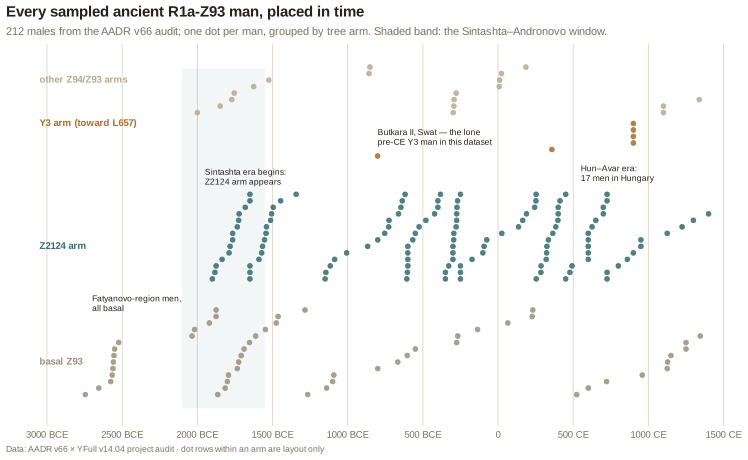
The nine pre-Sintashta specimens in the July audit come from the Russian forest-steppe and carry basal Z93 calls. In the July audit, Z2124 first appears in the Sintashta–Andronovo bin. At Tamir Ulaan Khoshuu, Keyser et al. (2020) report 16 R1a males, including ten at Z2125 and four at Z95. The July audit’s Y3-arm assignments after I12450 include specimens from the Alai Valley and the Volga region.
Teepean's community reanalysis of the Akbari release covers 9,908 individuals, of whom 5,514 have a Y call. Matching those calls to the FTDNA tree gives 145 at or below R-Z94, including 136 at or below R-Z2124 and zero at or below R-L657. Community call tally and inputs.
Akbari individuals in the Atlas catalogue
The Atlas catalogue, snapshot public-complete-aa0ad26187ea, places 234 individuals from the Akbari release under R-Z93: 122 at or below R-Z94, 115 of them on the Z2124 arm, and none at or below R-L657. An Akbari call whose label is on the Atlas tree is placed on that branch. A call whose label the tree does not list is placed on its nearest ancestor that the tree does list, following YFull’s tree; 48 of the 234 are placed this way. The 122 and 145 counts use different reference trees. The catalogue marks these dates as approximate and does not specify dating methods. The table uses those dates and the six bins of the July audit; bins are right-closed on BP as in the audit, and years are 1950 − BP.
| Era | Z2124 arm | Y3 arm | Other Z93 | Total |
|---|---|---|---|---|
| Pre-Sintashta, before 2350 BCE | 2 | 0 | 8 | 10 |
| Sintashta–Andronovo, 2350–1550 BCE | 3 | 0 | 31 | 34 |
| Late Bronze to Iron Age, 1550–850 BCE | 15 | 2 | 13 | 30 |
| Scythian–Saka–Xiongnu, 850 BCE–150 CE | 37 | 3 | 27 | 67 |
| Migration era, 150–950 CE | 52 | 0 | 32 | 84 |
| Medieval and later | 6 | 0 | 3 | 9 |
| All | 115 | 5 | 114 | 234 |
Two individuals carry Z2124-arm calls before 2350 BCE. I12502 dates to about 2450 BCE and is placed on R-S23592; the catalogue withholds its location. I12966 dates to about 2412 BCE and is placed on R-Y934, with a place inferred as Goluzinovo, Russia. Five carry Y3-arm calls before the Common Era. Two are placed by their own labels on R-SK2040 under R-FT12493: I26241, about 500 BCE, and I10517, about 336 BCE; both list Avlasovo? as an inferred site in Russia. Three are placed on the nearest branch the Atlas tree lists above their call: I20330 (R-M634, placed on R-Y27), about 1325 BCE, with a community-inferred label of Steppe_Afanasievo_EastAsian?; I23400 (R-BY32037, placed on R-F1417), about 900 BCE; and I8395 (R-M634, placed on R-Y27), about 275 BCE. All seven are community calls that have not been verified against sequencing reads, and all their dates are approximate, with no dating method given. The two Z2124-arm dates precede that arm’s earliest bin in the July audit. Of the Y3-arm dates, only I20330’s would precede I12450 in the audit (2751 BP); a single unverified call with an approximate date does not move that first occurrence. The July audit’s first occurrences describe its own 212-record set. The Atlas leaves I13265, which FTDNA Discover places on the Y3 arm, unplaced on its tree.
Our marker audit found that coverage at positions diagnostic for R-L657 varied across the 1240k specimens. FTDNA Discover places 13 of 362 dated specimens on the Y3 arm before the Common Era. They include I13265 from the anonymized Akbari release (about 1795 BCE), b8-2 from Nepluyevsky (1877–1642 cal BCE) and DA136 from Nesvetay-2. The Atlas records R-M417 for b8-2 and DA136. FTDNA assigns them to R-F2597 and R-M634, respectively. The dated register analysis lists the 13 calls.
Middle Don specimens from Kolbino I and Semiluk
In Table S33, Andreeva et al. assign R-Y2 (R-M732) to DS21 at Kolbino I and to DS32 and DS90 at Semiluk. Table S1 dates DS21 to the first half of the 4th century BCE, and DS32 and DS90 to the turn of the 4th–3rd centuries BCE. The authors assign DS67 at Kolbino I to R-Y2631 on the Z2124 arm. Its context dates to the second quarter of the 4th century BCE. Compare the four specimens in the Atlas.
Supplementary Note 7 names DS92 in the Semiluk R-Y2 group. The individual calls in Table S33 list DS90, and Table S1 records DS90 and DS92 as separate individuals. We use the Table S33 assignment for DS90.
Z2124 share by era
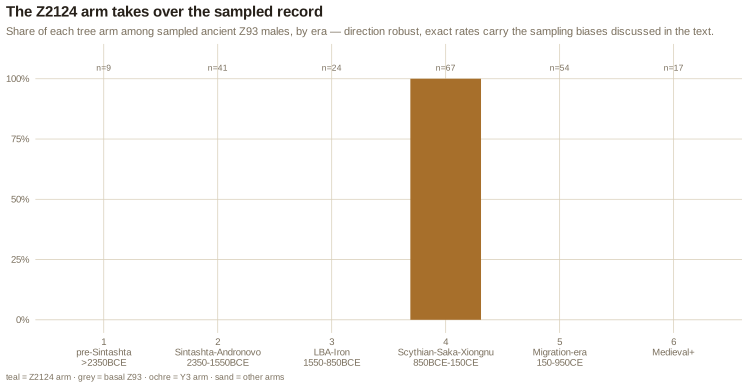
In our correspondence analysis, we recover the chronological ordering along the first axis, which accounts for 74% of the inertia. The west–east comparison of basal calls gives Fisher p = 0.73. Cemetery sampling and differences in marker coverage limit the demographic interpretation of the fitted trend. R outputs and data.
Geographic distribution of sampled specimens
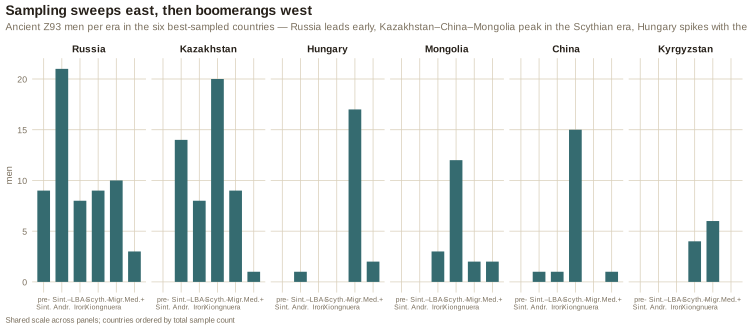
The August FTDNA register also contains 17 Migration-era specimens from Hungary, with estimated date midpoints spanning 315–820 CE. Sixteen are assigned to the Z2124 arm and one, Hegyko_20, to the Y3 arm. The July AADR and August FTDNA counts use separate inclusion and calling rules. The archaeological attribution of individual burials requires site evidence alongside the Y calls. FTDNA specimen register.

C1714 from Tangbalesayi is the earliest Z94-arm specimen from Xinjiang in the August register (1621–1510 cal BCE). Guanjingtai 7, C3316 (161 BCE–8 CE), remains a provisional R-L657 candidate. The CNCB BioSample identifies the specimen. Verification of the L657 observation requires examination of independent, end-trimmed reads and their strand support. C3316 · Published segments · CNCB SAMC1837927 · Marker evidence.
Reported paternal origins in volunteer kits
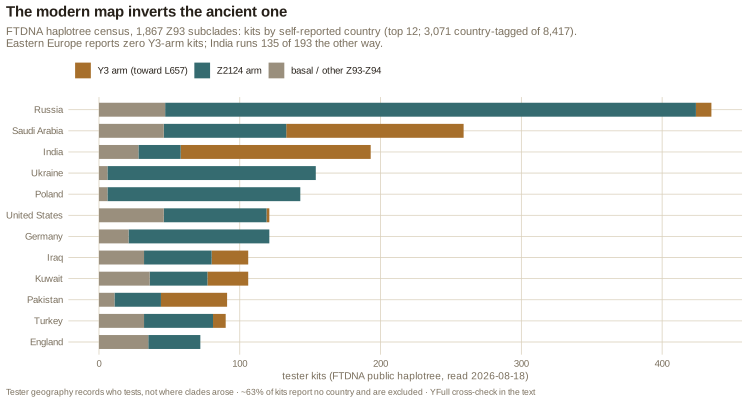
We count 135 Y3-arm kits among the 193 that name India. The corresponding rows for Ukraine, Poland and Lithuania contain zero Y3-arm kits among 154, 143 and 52, respectively. Russia has 11 among 435. The Y3 counts for Saudi Arabia, Kuwait and the United Arab Emirates are 126, 29 and 29. In our comparison of Y3 and Z2124 across four South Asian and five Eastern European country groups, Fisher’s exact test gives an odds ratio near 209 (p ≈ 6 × 10−139). The test uses the observed counts and leaves recruitment and self-reporting effects unestimated. Counts and test output.
The full August YFull Z93 subtree contains 1,085 records. The published geographic matrix covers 310 entries. Among the L657 entries, 37 report India, 16 Pakistan, nine Sri Lanka and eight Bangladesh. The basal Z2125* category has eight each from Pakistan and Afghanistan, and the S23592 category has 17 from Kyrgyzstan. The YFull geographic matrix gives the counts by branch.
In Underhill et al. (2015), 98.4% of 490 sampled Central and South Asian R1a lineages belong to Z93. The study reports Z2125 above 40% in its Kyrgyz and Afghan Pashtun samples and basal Z93* at 1–8% in the Iranian populations sampled and above 30% in the South Siberian Altai. In the Afghan survey by Haber et al. (2012), the broader R1a1a call occurs in 25 of 49 Pashtun men (51.0%). Rootsi et al. (2013) identify R1a-M582 in Ashkenazi Levites and compare it with related lineages in other populations. We count 17 of 48 men under Z93 in the 1000 Genomes Punjabi sample from Lahore (PJL) in Poznik et al.’s Y-chromosome call set.
Cohort overlap and sampling bias
The July AADR audit and August FTDNA register share 103 specimens. By fitting each cohort separately, we test whether the association with specimen date persists under different calling and inclusion rules. Replication requires an independently sampled cohort.
| Claim | AADR v66 audit (n = 212) | FTDNA register (n = 362) | Assessment |
|---|---|---|---|
| Association between date and Z2124 placement | logistic coef −0.27, p = 0.047 | coef −0.281, p = 0.012 | Both fits associate later dates with Z2124. Related burials reduce the effective sample size. |
| Z2124 share by era | 0% → 51% → 54% → 67% → 70% → 35% | 8% → 83% → 86% → 78% → 73% → 80% | The early increase appears in both cohorts. Their later bins differ in sample size and composition. |
| Pre-Sintashta Z2124 assignments | 0 of 9 | 2 of 24 | Inclusion rules and small early bins limit the comparison. |
| Pre-CE Y3-arm presence | 1 of 212 (I12450 from Butkara II) | 13 of 362, including five from the western forest-steppe | Differences in inclusion and marker resolution affect the observed counts. |
Low coverage can leave a sample assigned to a more basal branch when downstream markers are missing. Burial rites and preservation also affect which remains yield usable DNA. Ghalichi et al. (2026) identify close relatives within and across elite Iron Age kurgans, an example of a sampled cemetery contributing several members of one family. Chance variation in reproductive success can change lineage proportions in small communities. Our companion analysis examines how marker coverage limits the detection of ancient L657.
Branch ages and dated specimens
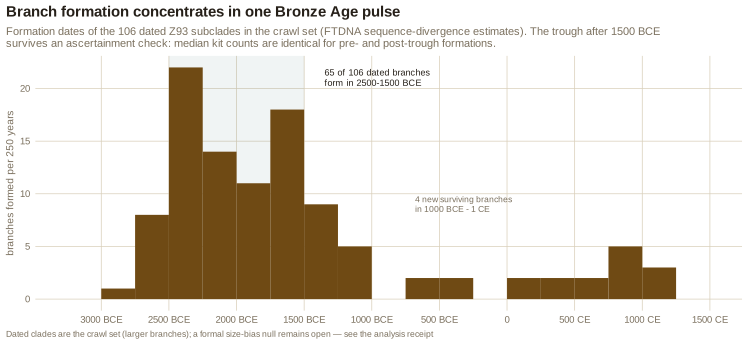
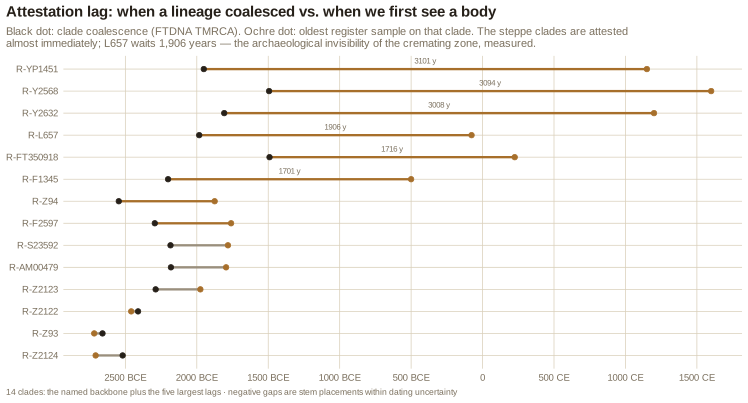
We place the FamilyTreeDNA estimates for dated branches alongside archaeological date ranges and specimen assignments. The coalescence estimate dates the last common paternal ancestor of the lines sampled on a branch. A dated specimen establishes that the lineage was present at the recorded site by that time. Each estimate carries its own uncertainty.
| Lineage | Estimate or specimen date | Archaeological context | Evidence |
|---|---|---|---|
| R-Z93 | 2660 BCE (68% CI 3008–2356 BCE) | Fatyanovo–Abashevo forest-steppe, c. 2900–2100 BCE | The coalescence estimate predates the Southern Urals radiocarbon series (2200–1770 cal BCE) and the early phase at Sintashta II (2004–1852 cal BCE). Epimakhov et al. (2023). |
| Z94, Z2124, Z2122 and Z2125 | Four point estimates from 2660 to 2415 BCE, with overlapping intervals | Pre-Sintashta | The estimated coalescences cluster before the Sintashta horizon. The temporal uncertainty permits several timings for the expansion of surviving branches. |
| R-Y2 arm | 819–785 cal BCE | Iron Age Swat | I12450 from Butkara II is the earliest sampled Swat carrier of the Y3/Y2 arm. The call R-Y337085 is on the sister branch of R-Y27 under R-Y2. |
| R-L657 | 1983 BCE (68% CI 2300–1707 BCE) | Modelled Swat admixture interval, 1900–1500 BCE | The coalescence interval overlaps the autosomal interval modelled by Narasimhan et al. (2019). The 1,906-year interval to C3316 (approximately 77 BCE) is provisional pending read-level verification of its L657 assignment. |
| R-Y2631 | 930 BCE (68% CI 1297–617 BCE) | Iron Age Middle Don | Andreeva et al. assign DS67 from Kolbino I to R-Y2631. The burial context dates to the second quarter of the 4th century BCE. The Middle Don comparison includes three R-Y2 carriers from the same regional record. |
| Z2124 subclades in the Carpathian Basin | FTDNA specimen date midpoints, 315–820 CE | Migration era | The August register assigns 16 of 17 specimens from Hungary to the Z2124 arm and Hegyko_20 to the Y3 arm. The July AADR audit assigns 14 of its 17 to Z2124. Maróti et al. (2022) discuss Hun-, Avar- and conquest-period individuals using their burial contexts and genome-wide data. |
| Y3-arm men, Volga–Kama | Four samples, c. 900 CE | Karayakupovo horizon | The August register places I19106, I19107, I19109 and I25489 on the Y3 arm. Gyuris et al. link the South Ural Karayakupovo horizon to 10th-century Hungarians using genome-wide data. |
| R-MF84025 (below L657) | 756 CE (68% CI 493–977 CE) | Early medieval South Asia | The FTDNA estimate provides a comparison with the ages of Asian paternal descent clusters reported by Balaresque et al. (2015), whose eleven clusters range from 2100 BCE to 1100 CE. |
Migration and founder hypotheses
We assess proposed movements against the dated specimens, archaeological contexts and branch ages. Early finds establish where a lineage was present. Routes and demographic mechanisms require evidence from additional sites and periods.
- All nine pre-Sintashta specimens in the July audit come from sites in present-day Russia. We consider the eastern European forest-steppe a plausible location for early Z93 coalescence given these dated finds.
- The July audit places 21 of 41 specimens in the Sintashta–Andronovo bin on the Z2124 arm. We consider expansion during the Sintashta transition a plausible explanation for the increase in sampled carriers.
- Andronovo-era connections offer a route for the eastward dispersal of Z2124. The dated record in Kazakhstan and Xinjiang establishes presence by the Late Bronze Age. An earlier local presence remains possible given the sampling gaps.
- A Bronze Age arrival of the Y3 arm in South Asia remains a hypothesis. I12450 from Butkara II dates its sampled presence in Swat to 819–785 cal BCE. The later DS21 at Kolbino I belongs to the Y3 arm in the Middle Don comparison.
- Endogamy and founder effects could contribute to L657 clustering in South Asia. The volunteer datasets describe the modern distribution among participating testers. Dating the spread to Bengal or Sri Lanka requires dated carriers or genealogies.
- Eastern steppe specimens provide Scythian-period dates for branches within Z2124, including Z2125 and Z2123. We would test proposed links to named groups such as the Yuezhi or Wusun against specimens from sites securely assigned to their archaeological contexts.
- Z2124 occurs repeatedly among the sampled Migration-era burials in Hungary. Assigning individual carriers to Hun, Avar or incorporated groups requires the burial evidence and regional chronology.
- Wen et al. (2021) use Y-STR variation to estimate a common ancestor 628–721 years ago for a Kyrgyz cluster within R-Z2125. We would test the cluster’s structure with deeper sequencing and dated specimens.
Predictions for future sampling
- A securely typed Z2124 specimen from central or eastern Kazakhstan before 2350 BCE would place the branch farther east at an earlier date than our proposed chronology.
- The Bronze Age arrival hypothesis predicts Y3 carriers in late Bronze Age samples from the Hindu Kush and northwestern subcontinent. A test needs usable reads at Y3 markers and distinct coverage at L657 markers to address that downstream branch.
- If limited marker coverage accounts for some basal Z94 assignments, read-level analysis of well-covered steppe genomes should place some of those men below Y3 or Z2124.
- If medieval founder events account for the sampled Kyrgyz Z2125 distribution, deeper sequencing should place many carriers in a few clusters with common ancestors after 1000 CE.
Methods, data and code
We downloaded the FTDNA public Z93 subtree on August 18, 2026 and summed the branch counts. The subtree contains 1,867 branches and 8,417 kits, of which 2,246 are Big Y. The country matrix sums the reported geographic labels by arm. On the same date, we retrieved YFull v14.05.00 pages for Z93 and nine subclades and used multiset subtraction on sample flags to define ten disjoint strata that sum to 1,085.
We matched quality-filtered ancient male Y calls from the July AADR v66 audit to the YFull tree and deduplicated the records. The 212 specimens supply the era tables and the AADR logistic fit. In the August FTDNA Discover register, 362 of the 363 deduplicated specimens have usable dates and enter the temporal comparison. The community reanalysis of Akbari et al. supplies a separate tally of assignments by branch. The underlying publication released sequence data for 10,016 individuals, and the Y calls in our tally are from the community reanalysis.
- Ancient specimens by era and clade includes the sample IDs, dates, localities and publications for 212 males.
- Modern country × stratum matrix.
- July AADR analysis output includes the era counts, logistic fit and correspondence analysis.
- The R scripts for the July audit, August register analysis and figures use local research inputs. The linked CSVs carry the tabulations.
- The FTDNA country matrix groups the 114 geographic labels by three arms.
- The FTDNA register analysis includes the era counts, the logistic fit (p = 0.012), the dated Y3-arm list and the Fisher test on volunteer kits.
- The FTDNA Discover ancient register has 363 deduplicated samples with terminal clade, site, coordinates, date, culture and study. Its three largest sources are the Akbari 2026 secondary calls (173), Narasimhan 2019 (30) and Gnecchi-Ruscone 2021 (21).
- The Universal Y-SNP Database provides country-level SNP maps from a largely European sample. The YFull R-Z93 tree provides branch definitions and sample flags.
Primary references
- Underhill et al. (2015) surveyed R1a subclades among 16,244 men.
- Pamjav et al. (2012) describe binary markers distinguishing the Z282 and Z93 branches.
- Rootsi et al. (2013) compare regional R1a lineages and the Levite M582 branch.
- Haber et al. (2012) report Y-chromosome haplogroup frequencies in sampled Afghan populations.
- Chang et al. (2023) report Hui Y-chromosome lineages, including Z93 in their Xinjiang and Ningxia samples.
- Keyser et al. (2020) report Y lineages from a Xiongnu cemetery.
- Narasimhan et al. (2019) analyse Steppe_MLBA ancestry and the Swat transect.
- Akbari et al. (2026) released sequence data for 10,016 individuals.
- Andreeva et al. (2025) report the Middle Don study specimens and their archaeological contexts in Tables S1 and S33.
- Ghalichi et al. (2026) analyse kinship within and across elite Iron Age kurgans.
- We read the FTDNA Discover R-Z93 tree and its ancient assignments on August 18, 2026.
- Poznik et al. (2016) analyse episodes of Y-chromosome lineage expansion.
- Wen et al. (2021) estimate the ages of paternal descent clusters among Kyrgyz groups.
- Zerjal et al. (2003) describe an Asian Y-STR cluster with an estimated age of about 1,000 years.
- Balaresque et al. (2015) estimate the ages of eleven Asian paternal descent clusters.
- Maróti et al. (2022) analyse Hun-, Avar- and conquest-period individuals in the Carpathian Basin.
- Gyuris et al. compare Karayakupovo-period Volga–Kama cemeteries with 10th-century Central European specimens.
- Epimakhov et al. (2023) reconstruct the Southern Urals Bronze Age radiocarbon chronology.
- Ralf et al. (2025) describe the Universal Y-SNP Database.